
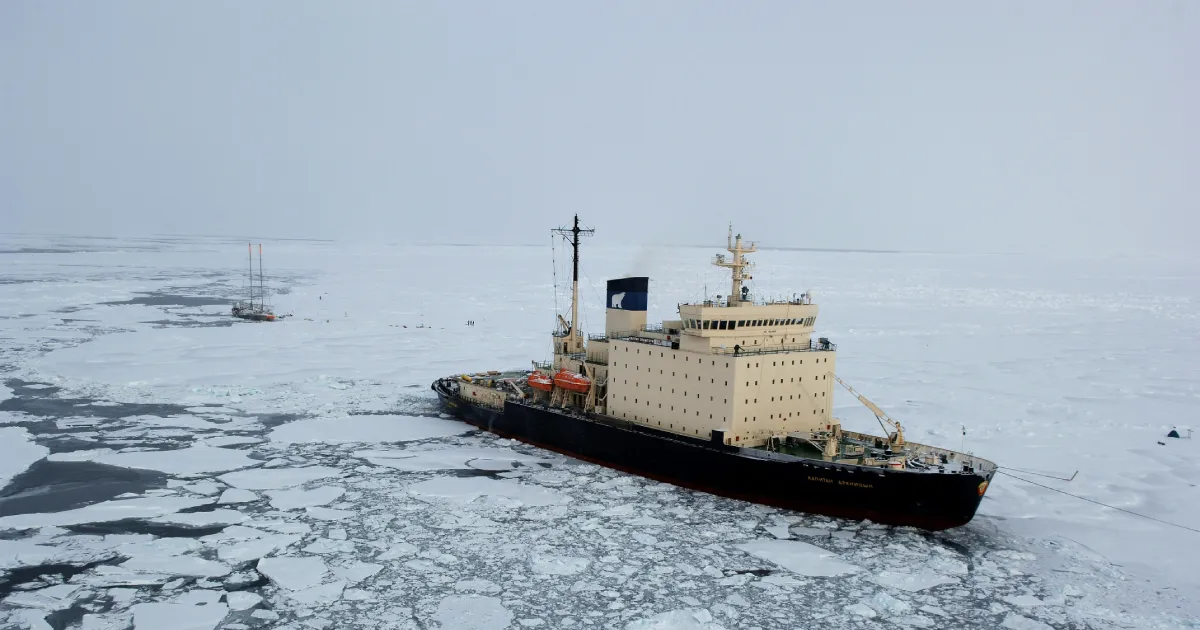
Things are heating up at the top of the world. The Arctic is warming much faster than the rest of the planet and the ice that once kept much of the region closed off is thinning. Countries are now looking north with renewed interest.
Sea ice has been one of the main barriers to commercial activity in the region, limiting shipping and making resource extraction difficult. But the terrain is changing. The National Oceanic and Atmospheric Administration (NOAA) said in 2025 the region’s winter sea ice maximum was the lowest in the 47-year satellite record, while the September 2025 minimum was the tenth lowest.
Arctic shipping routes may appear more attractive following Covid supply shocks, the Red Sea attacks, the Panama drought, Russia’s invasion of Ukraine and the return of industrial defence spending. It’s not that the Arctic has become easier to traverse, just that the rest of the globe has become more awkward to navigate.
Arctic Eight
No one country owns the Arctic. The Arctic Council consists of eight Arctic states: Canada, Denmark, Finland, Iceland, Norway, Russia, Sweden, and the United States.
The Arctic Eight each have territory within the Arctic and their national jurisdictions, alongside international law, govern land and waters around the Arctic Ocean. The region is also home to almost four million people, including Indigenous peoples, as well as more recent arrivals, hunters, herders, and city dwellers. Russia, Canada, and Denmark, via Greenland, have all been involved in Arctic seabed claims.
Canada and Denmark spent decades in a polite spat over Hans Island, a small rock between Ellesmere Island and Greenland. Soldiers left bottles of whisky or schnapps for each other, hence the Whisky War. In 2022, the two countries settled by dividing the island, giving Canada and Denmark a land border for the first time.
Shippers
The Northern Sea Route, which runs along Russia’s Arctic coast, could offer a 30% to 50% shorter distance between parts of north-west Europe and north-east Asia compared with the Suez route.
But journey times are not the only concern. Shippers will be mindful of reliability, cost, safety, insurance, port access, rescue cover, and legal risk. Arctic routes still face major problems on all of those points.
The Arctic remains seasonal and difficult to navigate. Ice conditions can change. Weather forecasting and communications are more demanding than in standard shipping lanes. Ships need trained crews and specialist equipment. The International Maritime Organisation (IMO) Polar Code is mandatory under both the SOLAS safety convention and the MARPOL pollution convention. It covers design, construction, equipment, operations, training, search and rescue, and environmental protection for ships operating in polar waters.
Search and rescue is a major issue. You don’t want things to go wrong in the Arctic. But when they inevitably do, the region has fewer repair facilities, not to mention harsher conditions than most major trade corridors. Research on Arctic freight shipping has highlighted hundreds of incidents over the past decade.
Beasts from the East
Much of Northern Sea Route cargo is linked to Russian Arctic projects rather than container ships. Although traffic on the Northern Sea Route has increased, it is still small compared with the main global shipping lanes. But cargo shipped along the Northern Sea Route reached about 37.8 million tonnes in 2024, a record level.
Russia’s outsized regional influence also creates risk. In a crisis, Russia could make access harder by delaying permits, changing requirements, prioritising friendly countries, raising costs, or creating enough uncertainty that Western insurers and shippers avoid the route.
After Russia’s full-scale invasion of Ukraine in 2022, the seven other Arctic states paused their participation with Russia in the rotating chair. Some projects and virtual work has since restarted but the split shows how quickly Arctic cooperation can be dragged into wider geopolitics.
China is not an Arctic state, but it wants a say in what happens there. In its 2018 Arctic policy white paper, China described itself as a “near-Arctic state” and said it wanted to participate in Arctic governance, shipping, research, environmental protection, and resource development. The same policy linked Arctic shipping to the wider Belt and Road Initiative through the idea of a Polar Silk Road.
Icebreaker
Less sea ice may create more navigable water for more of the year. But this is not the Mediterranean. The region still requires specialist vessels and crews, and states willing to spend heavily on polar capability.
Vast ships called icebreakers keep routes open, escort other vessels, assist rescue operations, and signal presence. Russia has the world’s largest icebreaker fleet and, more importantly, the most serious heavy and nuclear icebreaker capability.
NATO has icebreakers too, especially through countries like Canada, Finland, Sweden, and Norway, but the US itself has very limited heavy polar capacity. That is one reason Washington is leaning on Finland and Canada through the ICE Pact, designed to rebuild allied icebreaker know-how and shipbuilding capacity.
Not for sale
The US Geological Survey estimates the Arctic may hold about 13% of the world’s undiscovered conventional oil and 30% of its undiscovered conventional natural gas. That’s around 90 billion barrels of oil, 1,669 trillion cubic feet of natural gas, and 44 billion barrels of natural gas liquids, with around 84% expected offshore.
Arctic energy projects are expensive, difficult, exposed to environmental scrutiny, and vulnerable to sanctions. They sit awkwardly inside the energy transition. The same climate change that makes some Arctic areas more accessible is caused in large part by the fossil fuels that some companies want to extract.
Donald Trump’s repeated interest in taking control of Greenland has already sparked a diplomatic crisis, with Greenlandic leaders stressing that the country is “not for sale”. Recently, Trump’s special envoy, Jeff Landry, arrived in Nuuk saying he was there to “look, listen and learn”, while Greenland’s prime minister Jens-Frederik Nielsen used the meeting to restate the more important point: Greenlanders have the right to self-determination.
Cold war
For NATO, the High North has become more important after Russia’s invasion of Ukraine and the accession of Finland and Sweden. The northern flank now links the North Atlantic, the Baltic region, and the Arctic more closely. For Russia, the Arctic is linked to national defence, nuclear submarines, energy exports, and control over the Northern Sea Route.
The Arctic is central to Trump’s proposed Golden Dome missile shield, because any system designed to track and stop missiles aimed at North America would rely on early-warning radar, satellites, and communications across the High North. Undersea cables, pipelines, sensors, and energy infrastructure are also becoming more important as activity in the region grows.
Top of the world
On most maps, the Arctic sits at the top, wide and blank, empty space above the real action. But viewed from the pole, North America, Europe, and Asia sit around the same ocean.
New shipping routes and resource projects may bring infrastructure and strategic interest. But the Arctic is home to people, towns, borders, and ecosystems that are already under pressure. More attention there also means more risk and disruption. Its future is unlikely to be one dramatic opening but a series of smaller incursions, each adding to the next, as the ice recedes and the sea opens up.
The value of your investments can go down as well as up and you may get back less than you invest.
Freetrade does not give investment advice and you are responsible for making your own investment decisions. If you are unsure about what is right for you, you should seek professional advice.


.webp)


.avif)
.avif)