We thought we couldn’t get away with it in Europe... and then Italy did it. And we realised we could.
— Neil Ferguson, architect of UK lockdown
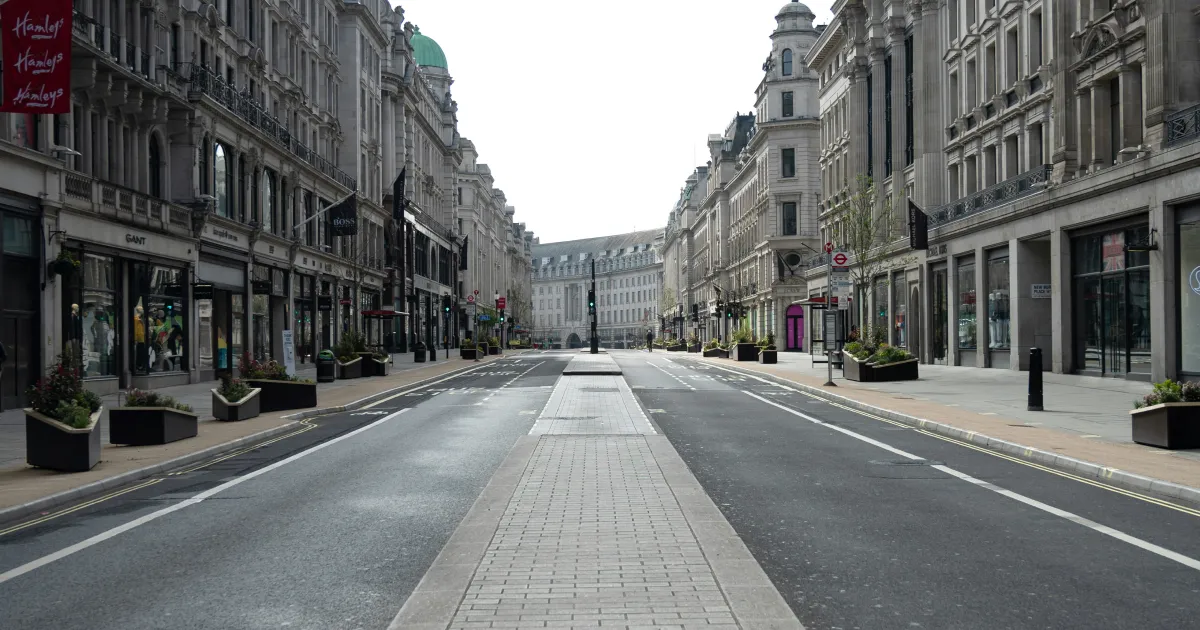
Six years ago, 27 million people watched UK Prime Minister Boris Johnson tell them to ‘stay home’ to tackle the spread of coronavirus.
The PM said you should only leave home to exercise once a day, travel to and from work where absolutely necessary, shop for essentials and fulfil medical needs. He also ordered the immediate closure of shops selling non-essential goods. These rules constituted some of the most far-reaching curbs on personal freedom in modern history. Arguably, we have still not yet appreciated the full cost of these unprecedented measures.
Three weeks
Over 2020/21, Britain endured 185 days of civil disruption across three lockdowns. Forgetting the direct human cost of these policies for a moment, by shuttering its economy, Britain is, now more than ever, a low-growth, high-tax nation where the state is too broke to fix many of the problems the country faces.
The UK economy has not returned to its pre-2020 path. Even allowing for the B-word, Britain is now materially poorer than it was expected to be before the pandemic. That missing wealth has been replaced by a debt-servicing bill that now consumes more of the national budget than the entire Ministry of Defence.
Stasis quo
To fund lockdowns and associated policies like furlough, the government increased borrowing to £303.1 billion in 2020/21, the highest since records began in 1946. In March 2020, just before the first lockdown, the Office for Budget Responsibility forecast borrowing for 2020/21 at £55 billion. The total cost of government Covid measures has been estimated at around £311 billion to £376 billion.
Back then, interest rates were at historic lows. Different times. But Britain is now set to spend around £111.2 billion on debt interest in 2025-26, roughly 8.3% of all public spending. Much of that reflects the insane scale of Covid-era borrowing, with the pain intensified by higher interest rates used to suppress the inflation that followed lockdown stimulus, pent-up demand, broken supply chains and the post-Ukraine energy shock.
Assetflation
Even with nominal wage increases, the resulting inflation shock wreaked lasting damage on household purchasing power and economic confidence. The social contract, already shaky, has been shredded by the devaluation of the currency. Inflation is a helluva tax.
That tax wasn’t helped by the Bank of England’s quantitative easing (QE) policy: roughly half of the total QE stock at its end-2021 peak was added during the pandemic and its immediate aftermath, topping out at £895bn.
The effects were not evenly distributed. QE and low rates helped sustain the value of houses, equities and other assets while inflation weakened the value of cash, widening an already existing divide between asset owners and wagies.
Bureaupathy
Court dates, driving tests, passport renewals, hospital appointments – the UK bureaucratic state is rusted by Covid inertia.
This bureaupathy – the chronic post-Covid malaise of the state – is still impacting justice in Britain. The Crown Court backlog in England and Wales stood at 76,957 cases at the end of March 2025, up from 40,173 at the end of March 2020. By the end of September 2024, the average time between a Crown Court case being received and completed had risen to 253 days, up from 143 days at the end of March 2020.
In the NHS, the waiting list in England was 7.29 million in December 2025, even after the NHS delivered a record 18.4 million treatments and operations in 2025. By December 2024, only 71.1% of A&E patients were admitted, transferred or discharged within four hours, far below the NHS standard of 95%. The system is working flat out and still failing to clear the jam.
Ultimate sacrifice
It’s estimated the average UK pupil lost 115 days of in-person schooling across the three lockdown periods. Now, the first Covid cohort is entering the labour market.
Employer perceptions are sobering. In 2024, research found only 28% of employers recruiting 16-24-year-olds thought they were well prepared for work, with many reporting gaps in communication, workplace behaviour and other social skills. Things like learning how to negotiate, concentrate, present, improvise.
One OECD paper suggests affected students could earn around 3% less over their lifetimes, while nations could see annual GDP about 1.5% lower for the rest of the century unless those losses are tackled.
Shuttering schools didn’t just put a dent in learning. Years later, persistent absence is still much higher than it was before Covid: 19.2% of pupils in England were persistently absent in autumn and spring 2023/24, against 10.5% in 2018/19.
Younger adults are now more likely than their elders to report feeling lonely, suggesting the social aftershocks of the pandemic have not fallen evenly. Many were NEETed into inactivity just as they were starting out – about 183,000 more than before the pandemic. Alan Milburn, who is chairing a government review into the causes of youth unemployment, said, “There’s a broader fear parents and grandparents have, that their kids are not going to do as well as we’ve done. That’s the first time that’s really happened in a century.”
Airportification
Millions of adults never came back either. Some left the labour market through long-term sickness. Some simply reassessed what work was worth, particularly those nearing retirement anyway.
During Covid, offices emptied and commuting patterns shifted. And the habit has stuck. As a fuel crunch looms today, ministers are again discussing WFH measures as a way to curb demand. These pandemic-era shifts in working saw urban businesses such as sandwich shops, station kiosks, and dry cleaners implode almost overnight, particularly if they were self-employed.
The Covid response prompted shopping habits that favoured global digital platforms over local brick-and-mortar high streets. Internet sales jumped from about 20% of retail sales in 2019 to 28% in 2020, peaking at 37% in February 2021. Amazon’s UK revenues surged from £13.7 billion in 2019 to more than £23 billion by 2021. The spike did not last, but online shopping has remained higher than before Covid.
Covid also accelerated what you might call the airportification of everyday life. More signs, more barriers, more signing in, more one-way systems, more scanning, more apps, more QR codes, more faff. The idea the public realm should be informal and casual has given way to something micromanaged and almost infantilising: a society run like a departure gate.
Mission creeps
Lockdowns reoriented the relationship between citizen and state. Democracies now have in their back pocket the mandate, when needed, to suspend hard-won freedoms. The Covid era proved that an appeal to collective safety is an effective tool for mass compliance.
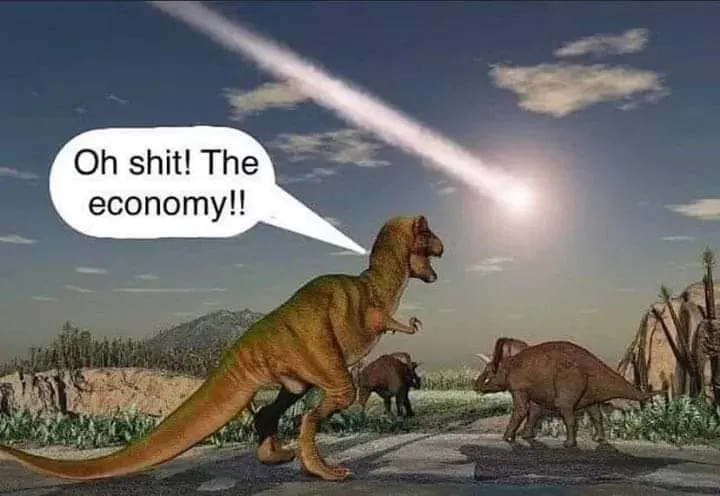
There was a meme doing the rounds in the early days of lockdown: a group of dinosaurs looking up at a world-ending meteor, asking, “But what about the economy?” It was meant as a gotcha for anyone questioning the wisdom of shutting down society. But it missed a fundamental point. Material security is not divorced from life and death. Poverty kills. Economic harm has measurable implications for mortality, from deaths of despair to fuel poverty and homelessness. Wealth is health.
Wuhan blueprint
Pandemic control relies on millions accepting small private sacrifices for the greater good. That tends to sit more easily in collectivist cultures than in highly individualised ones. Research during Covid did find collectivism was associated with stronger compliance.
But even in authoritarian China, compliance was never total. Zero-Covid provoked visible public resistance by 2022, and support varied depending on where people lived and how hard the restrictions hit their work and daily lives.
Culture was only part of it. State competence and prior epidemic experience mattered as much, if not more. Cross-country studies found higher trust in government was associated with better outcomes, while East Asia’s early success has also been linked to stronger administrative capacity and lessons learned from earlier outbreaks.
So, what was our government supposed to do?
Follow the science
Britain’s pre-Covid pandemic strategy posited something far more proportionate: testing and tracing, clear guidance, local closures, and normal life continuing where possible. The 2011 UK Influenza Pandemic Preparedness Strategy was explicitly against blanket measures such as transport controls and bans on gatherings.
Then came the WHO-China Joint Mission to Wuhan in February 2020. When leader Dr Bruce Aylward returned praising China’s response, “What China has demonstrated is, you have to do this”, what was once authoritarian became acceptable.
Other countries did, in fact, try different strategies. South Korea leaned hard on testing, tracing, isolation and public cooperation. Japan relied more on softer restrictions. Taiwan bought time with border controls, quarantine and aggressive case management.
Sweden’s approach was the most stark of all: no lockdowns, no mask mandates, and primary schools remained open, relying instead on voluntary social distancing, for example. Sweden was not the disaster its critics predicted. In some Europe-wide excess mortality comparisons it performed relatively well, though not as well as the best-performing Nordics.
Tin foil mask
There’s an irony here, adopting our Covid containment strategy from China. The outbreak began in Wuhan, the home of China’s leading institute for bat coronavirus research. The idea Covid-19 escaped from a lab is no longer a fringe internet conspiracy theory. Multiple US three-letter agencies believe a laboratory-associated incident is the most likely explanation, even if with low confidence. The UK has not gone that far, but it has joined allies in pressing China to be more transparent and to cooperate with an investigation into the virus’ origins.
US intelligence has said some of the work at the Wuhan Institute of Virology (WIV) had inadequate biosafety precautions. But there is no proof the lab had SARS-CoV-2 before the outbreak, and no evidence of a specific accident that released it.
But absence of proof is not proof of absence, especially when the files, databases, and notes that might clarify matters remain undisclosed. China has refused to provide the records that would settle it, according to the World Health Organisation. Without accountability, there can be no learning.
Flatten the curve
In an alternate reality where the pandemic never happened, Britain would still have its fair share of structural issues. But lockdowns were a major accelerant. They widened the asset divide, deepened state backlogs, scarred a generation, entrenched corporate concentration, and normalised emergency rule. The state’s own inquiry says the lockdown era left lasting scars on society and the economy.
Be in no doubt, there will be another germ. Whether it comes out of a lab or a wet market or outer space, we will be told there is no alternative. There is. Emergency powers should face a much higher bar. Children should be last in line for disruption. Work, enterprise and everyday life should be preserved where absolutely possible.
The real danger isn’t just the pathogen, but the strengthened state apparatus and policy muscle now ready for it, primed like a trap ready to spring shut: close, ban, suspend, borrow, print. Six years on, Britain is still paying for a policy sold as a mere three weeks.
The value of your investments can go down as well as up and you may get back less than you invest.
Freetrade does not give investment advice and you are responsible for making your own investment decisions. If you are unsure about what is right for you, you should seek professional advice.
.webp)
.avif)