
The resilience of the AI trade is facing a real test, with chip stocks and other players in the boom pulling back since early October.
AI jitters are pervasive, as investors worry if the tech can deliver the kind of profits that will justify massive capital expenditure. The recent scandal and accompanying share price toing and froing from Nvidia have only added to the noise. This might have left your portfolio suffering from AI whiplash.
While many Freetrade users have been buying the dip, as shown in our latest update of the most-bought stocks, others might be looking for some less techy options. So, what are Freetrade users buying outside of the AI trade?
Just to be clear, this list excludes companies where AI is a major facet of the investment story, including chipmakers and businesses supplying infrastructure for the AI buildout.
Methodology: Rankings based on the total executed value of buy orders placed by Freetrade customers from 7 October 2026 to 25 November 2026. The figures reflect buy-side activity only and do not account for sales, holding periods, or individual portfolio weightings. Stocks with significant AI exposure are excluded.
The London look
Londonmaxxing is all the rage right now. Boris bikes. Big Ben. Bow Bells. It’s all bloody brilliant.
Freetrade users clearly think the capital’s stock exchange has a lot to offer too.
Broadly speaking, the LSE has a distinctly different flavour to New York’s Nasdaq. While the latter is chock-full of cutting-edge tech and growth stocks with sky-high price-to-earnings ratios, the London market is home to sector powerhouses with long lifespans and reliable dividend payments.
All eight London-listed stocks here pay a dividend. That might not seem to differentiate them an awful lot from Freetrade users’ run-of-the-mill favourites, as six of the US heavyweights that topped Freetrade’s most-bought list in October offer dividends too. The difference is all in the yields.
For example, Microsoft yields around 0.8%, while Lloyds’ dividend yield is over 4% and Legal & General’s is at 7%. The heft of these dividends is likely a major attraction for investors, and the drip-drip-drip of income coming into your portfolio, or being reinvested, can be a reassuring sight when markets are volatile.
But dividends are usually performance-based, and can be cut. As such, it’s worth looking at key drivers for each of these stocks, and what investors are actually buying into. After all, the group are not a blob.
For example, top-of-the-tree Legal & General (LGEN) is demonstrating how profitable the business of retirement can be. It has onboarded several massive workplace defined contribution pension schemes, considerably upping its level of assets under management.
In addition, higher interest rates have helped its retail annuity business to boom. Sales are up 25% to £1.5bn in the first nine months of 2026, and this new business has seen margins improve from 4.5% to 5.5%.
The twist is that its asset management arm suffered £28bn of net outflows over the same nine months, up from £8bn a year earlier.
Pensions and investments are also key to Aviva (AV), but it’s in the business’s insurance arm that the excitement is right now. Here, the ongoing integration of Direct Line, acquired in July 2025, has helped general insurance premiums to climb by 19% to £11.8bn across the first three quarters of 2026.
Margin improvements mean the business has been keeping a greater proportion of those premiums too.
Then, there’s the banks. As major lenders, Lloyds (LLOY) and HSBC (HSBA) are both also able to benefit from higher interest rates. Central bank rate increases, like this month’s hike to 4% from the Bank of England, can allow them to increase rates on lending products and widen the net interest margin between what they earn on loans and offer on deposits.
However, Lloyds has greater exposure to the UK market, while HSBC has a huge presence in the Asia.
For oil majors BP (BP) and Shell (SHEL), it’s all about exposure to the energy price shock. Elevated commodity prices and refining margins have seen Shell’s profit attributable to shareholders more than double to $28.6bn across the first nine months of the year, while BP’s more than tripled to $12.4bn.
The big question facing them is how long higher oil prices will last, and just how effectively they are taking advantage of the payday.
Finally, defence and pharmaceuticals might seem worlds apart, but BAE Systems (BA) and GSK (GSK) actually have a lot in common. They deal in cutting-edge tech, invest heavily in research and development, and have sources of demand that hold up while households are cutting back.
For BAE, customers are often governments placing orders for military equipment years before they need it. By mid-November, it had secured £33bn of orders since the start of the year as the firm benefits from beefed-up military spending in the UK and broader Western world.
Meanwhile, demand at GSK depends on the medicines doctors prescribe, the treatments health services and insurers will pay for, and the vaccines governments buy for national programmes. As such, the business is under pressure to develop effective treatments and therapies.
It’s had recent success in oncology, where Q3 sales were up 22% YoY to £0.62bn as a downturn in sales of its oral cancer treatment Zejula was more than mitigated by success from candidates. This demonstrates the strength of a broad stable of treatments at market.
Are you watching closely?
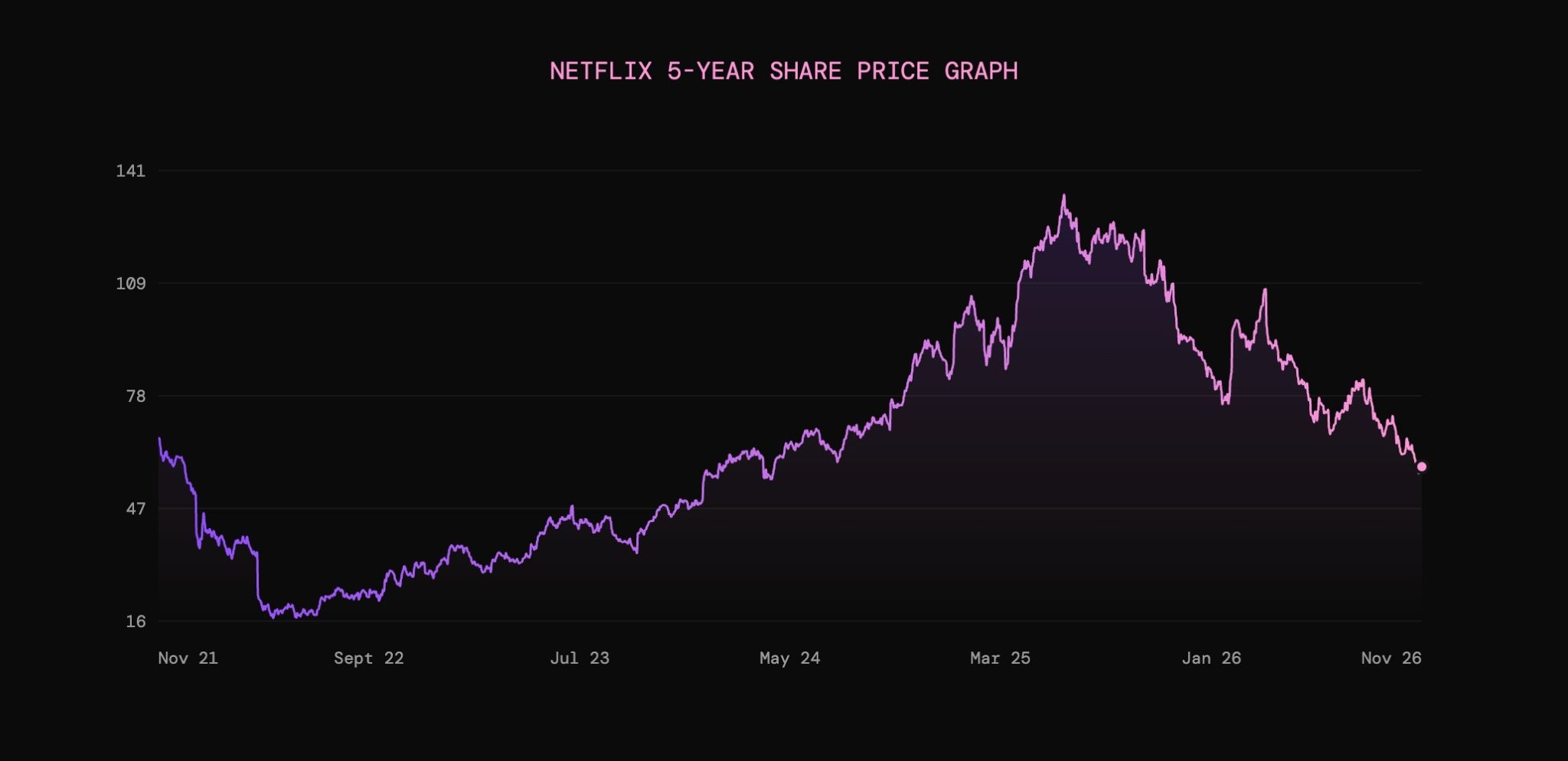
Netflix’s (NFLX) share price is down by more than a third YTD, even as the business appears to deliver compelling top-line growth. The downturn appears to be in the details.
Operating profits leapt by 37.3% to $4.46bn in Q3. More viewers are still signing up to the streamer, and members are paying higher prices for subscriptions, powering Q3 revenue 11.8% higher to $12.9bn.
But that was the slowest growth Netflix had reported so far this year. A further brake pedal to 11.5% revenue growth is expected in Q4, down from 17.6% in Q4 2025.
The issue is that advertising revenue hasn’t delivered in the way Netflix had hoped, with the business cutting 2026 ad revenue forecasts from around $3bn to $2.7bn in its Q3 earnings.
Advertising was meant to step in and add a bit of rocket fuel to revenues as subscription growth faced questions of saturation. While Netflix’s surprising growth in users across the YTD might have papered over the issue for now, the streamer needs to get this alternative revenue stream firing, particularly after Q3 delays to new advertising tooling led to an outlook trim.
Even so, Netflix is a one-time growth stock darling, and its solid headline gains appear to have caught the eye of Freetrade users looking for growth outside AI.
Different spec
Finally, Strategy (MSTR) is potentially the most interesting stock here. Because what Strategy, formerly known as MicroStrategy, offers is a different kind of speculation to the AI trade.
The company is an oddball. It might have a small hand in enterprise software, but really Strategy is all about the coins.
We’re talking crypto, as Strategy is the planet’s largest corporate HODLer of Bitcoin. The company has a colossal 851,305 units of the stuff as of its weekly count on 23 November.
As such, the company’s stock acts as a bit of a proxy for Bitcoin, with an extra wrinkle. Strategy raises money by issuing securities, so shareholders are also betting on how well it finances and executes its buying habit. For Freetrade users, that seems to be a compelling enough question to gravitate to the stock, and it might also prove an interesting avenue for those tired of speculating on the AI trade.
Capital at risk. The value of your investments can go down as well as up and you may get back less than you invest.
Fluctuations in foreign exchange rates may affect investments denominated in currencies other than GBP and the amount you receive back.
Past performance is not a reliable indicator of future returns.
Freetrade does not give investment advice and you are responsible for making your own investment decisions. If you are unsure about what is right for you, you should seek professional advice.