Cacao was knocking about in Mesoamerica more than 3,000 years ago. Residue found on Olmec pottery suggests people were drinking it by around 1500 BC. For most of its history it was a bitter, frothy drink, often spiced with chilli. Not quite a bar of Dairy Milk.
By the time the Spanish arrived, the Aztecs were using cacao beans as currency. A 1545 price list from Tlaxcala puts a turkey hen at 100 beans. And, of course, where there is money there is forgery. Counterfeiters would empty the husks and refill them with mud or wax.
The Spanish took cacao home in the 16th century, added sugar, and kept it largely to themselves. It reached London in 1657, when the city’s first chocolate house opened. White’s, the gentlemen’s club on St James’s Street, began life in 1693 as Mrs White’s Chocolate House.
Hot chocolate
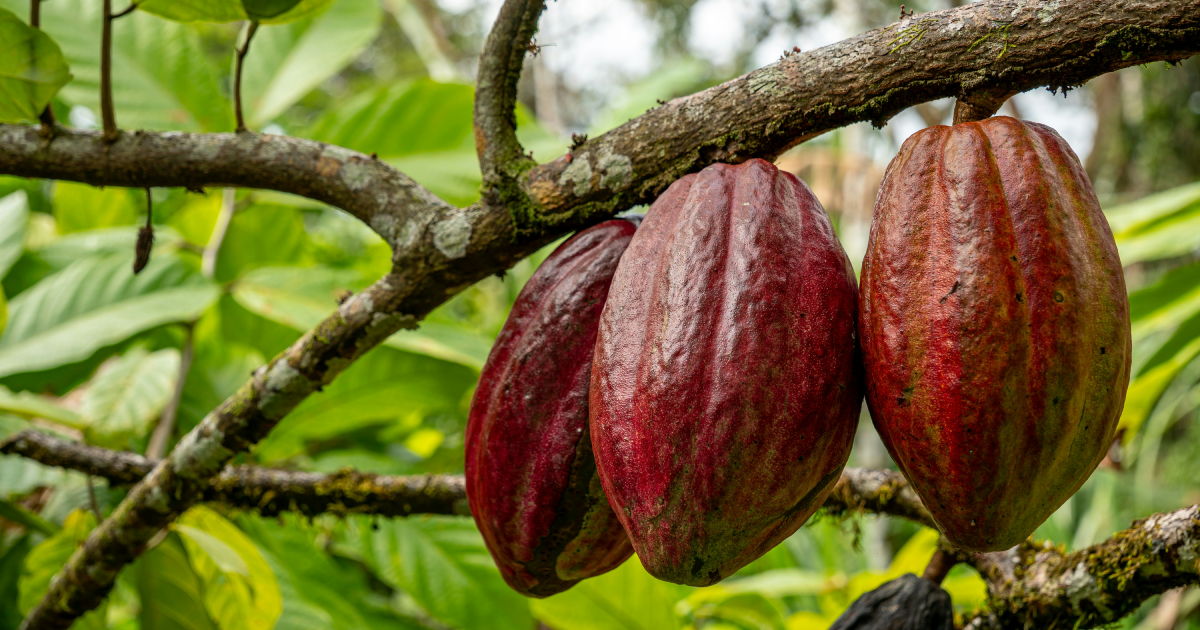
Cacao beans grow in a thin band around the equator, roughly 20 degrees north and south. Theobroma cacao needs heat, humidity, shade, and plenty of rain, and takes three to five years to produce a crop. The pods grow straight out of the trunk, each holding 30 to 50 beans wrapped in white pulp.
Those beans are fermented, dried, shipped, roasted, ground, and pressed. The tree was named by Carl Linnaeus in 1753, and the genus name – theobroma – translates as food of the gods. Most of the world’s supply now comes from a small corner of West Africa.
Thee and cocoa
Chocolate as we know it is a 19th century invention. In 1828, Coenraad van Houten patented a press in Amsterdam that squeezed cocoa butter out of the beans, leaving a powder behind. Treating it with alkaline salts, now known as Dutching, made it milder and easier to mix. Once you could separate the butter from the solids, you could recombine them in new ways.
J.S. Fry & Sons in Bristol produced what is often credited as the first chocolate bar. Fry, Cadbury in Birmingham and Rowntree in York were all Quaker firms. Barred from the universities and the professions, Quakers went into trade. Chocolate was a respectable alternative to alcohol. Cadbury’s Bournville model village, begun in 1893, was famously dry.
Daniel Peter made the first milk chocolate in 1875 using condensed milk from his neighbour Henri Nestlé, and Rodolphe Lindt invented the conch in 1879, a machine that churned the mixture for hours until it was smooth. In the US, Milton Hershey launched his milk chocolate bar in 1900 and built a town in Pennsylvania where the street lights are shaped like Kisses. Fry merged into Cadbury in 1919, Nestlé bought Rowntree in 1988, and Kraft took over Cadbury for £11.5bn in 2010. Cadbury now sits inside Mondelez, which was spun out of Kraft in 2012.
Gold Coast
Cocoa reached West Africa via the Portuguese and Spanish colonies in the Gulf of Guinea. Within a few decades the Gold Coast was the world’s biggest producer, and Ivory Coast overtook it in the late 1970s.
Today, Ivory Coast grows more than a third of the world’s cocoa, with Ghana in second place. Four West African countries produce around three quarters of global supply. Most of it comes from millions of smallholders farming a few hectares each. Ivory Coast and Ghana share a border and are hit by the same weather, and no other country grows enough cocoa to fill the gap when both have a bad year. Both governments also set the farmgate price at the start of each season, which means farmers are paid a fixed rate whatever the futures market does.
Pod luck
For about four decades cocoa traded between $1,000 and $4,000 a tonne. But lately, harvests have struggled to keep up with demand, thanks to ageing trees, swollen shoot virus, and black pod disease across Ghana and Ivory Coast. The trouble began in 2023 with heavy rain during Ghana’s dry season, followed by drought.
Crop losses were made worse by smuggling and by farms being given over to illegal gold mining, known in Ghana as galamsey. The International Cocoa Organization counted a third straight global deficit in the 2023/24 season, and global stocks fell to their lowest level relative to consumption in 47 years.
On 18 December 2024, cocoa hit a record of $12,931 a tonne. But better weather and weaker demand have pushed stocks back up, with warehouse inventories reaching a two-and-a-half-year high in mid-November. On 10 November, the price fell to a four-month low of around $4,650 a tonne. The market is still a little jumpy. Ivory Coast port arrivals in the first week of November were roughly half the level of a year earlier, and a strong El Niño threatens to bring harsher, drier winds just as the main crop comes in.
If you like a lot of chocolate
Manufacturers have three levers to pull: shrinkflation, higher prices, and cutting the cocoa content. UK rules set minimum cocoa levels for a product to be called milk chocolate. In 2025, McVitie’s Penguin and Club bars dropped below that threshold and had to be relabelled as chocolate flavour.
Come December, the EU’s deforestation regulation will kick in. Importers will have to prove their cocoa was not grown on recently cleared forest. The four big West African producers send around two-thirds of their exports to the EU, and in Nigeria potentially less than half of the output there could meet the rules.
High prices have pulled new growers in. Ecuador, Brazil, and Peru expanded planting during the boom, and Peru has since felt the comedown, with raw cocoa export revenue falling to $210.6mn in the first seven months of 2026, from $510mn a year earlier. Then there is chocolate without cocoa. Start-ups such as WNWN in the UK and Planet A Foods in Germany make chocolate alternatives from fermented grains, seeds and carob, while others are trying to grow cacao cells in bioreactors. None of them comes close to the scale of West Africa’s harvest yet.
Talking turkey
A dried cocoa bean weighs roughly a gram, so the Tlaxcala turkey hen cost about 100g of cocoa. At the December 2024 peak, that was worth around $1.29. At this month’s low of about $4,650 a tonne, it was nearer 47 cents.
Cocoa farmers are estimated to receive a small share of a bar’s ultimate price, with the rest split between processors, manufacturers, retailers, and the taxman. During the spike, Ivory Coast and Ghana raised their fixed farmgate prices, but those still sat well below what the futures market was paying.
Mockolate
The tree’s hold on chocolate may not last. Vanilla went first: vanillin was synthesised in 1874, and almost all commercial vanillin today is synthetic. Chocolate has started down the same road. Nestlé now sells a cocoa-free chocolate product, and Mondelēz has produced bars from cell-cultivated cocoa.
Theobromine, cocoa’s bitter compound, and the reason chocolate is poisonous to dogs, takes its name from Linnaeus’s genus. The cocoa-free bars contain none of it. WNWN made a point of advertising its chocolate as theobromine-free, safe for dogs, which also makes it the first chocolate with no trace of the food of the gods.
The value of your investments can go down as well as up and you may get back less than you invest.
Freetrade does not give investment advice and you are responsible for making your own investment decisions. If you are unsure about what is right for you, you should seek professional advice.