
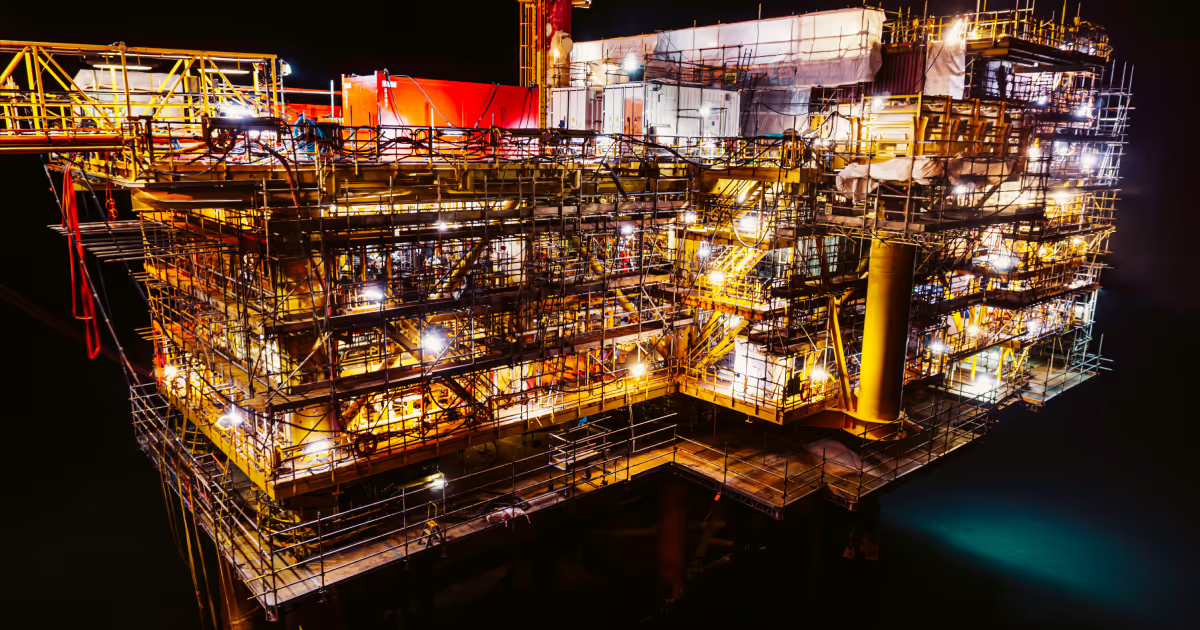
Modern economies run on hydrocarbons. Oil and gas are still the primary drivers of transport, heating, and power. The reality is hydrocarbons will remain a fundamental pillar of our energy mix for decades, not least because our grid infrastructure is years from being able to handle a total pivot to renewables. Beyond fuel, hydrocarbons are essential raw materials for chemicals, plastics, and fertilisers.
The average person in the developed world ‘consumes’ about two gallons of crude oil every day. Petrochemical feedstock accounts for roughly 12% of global oil demand, a figure expected to rise because there are no scalable alternatives for high-performance materials. We produce 400 million tonnes of plastic annually. Replacing that infrastructure will take decades.
Blood clot
This week, with the Middle East on fire, Iran moved to blockade the Strait of Hormuz, threatening to set ships “ablaze”. This 21-mile-wide passage is the world's ultimate chokepoint: 20% of global oil and liquified natural gas (LNG) shipments flow through it.
Traffic has already cratered as insurers pulled coverage and shipping lines diverted vessels. This is a massive problem for the UK because LNG flows are harder to buffer than crude. Unlike oil, which sits in strategic reserves, gas is often traded just-in-time. With Qatar’s LNG operations facing disruption, European gas benchmarks have spiked. Which leads directly to higher electricity bills at home.
After Russia’s invasion of Ukraine, the UK felt the effects of a wider European gas shock even without the same direct dependence on Russian pipeline gas as some of its neighbours. Higher wholesale gas prices fed into household bills, industrial costs, and inflation. Energy insecurity does not stay in one region for long.
Save the whales
Hydrocarbons weren’t always the bad guy. In the 1840s, Abraham Gesner developed kerosene from bituminous materials. At the time, we were driving the Right Whale and Sperm Whale to extinction because whale oil was the only clean burning light source for lamps.
Kerosene saved the whales by providing a cheaper, more efficient alternative. Commercial drilling at scale kicked off with the 1859 Drake well near Titusville, Pennsylvania, the first commercial oil well in the US. Back then, Colonel Drake hit oil at just 69 feet deep. Today, we are drilling the Komodo-1 well off Colombia at a water depth of 3,900 meters.
Managed decline
Why aren’t we drilling more in our own backyard? The UK still relies on oil and gas for 75% of its total energy needs, yet production in the North Sea is in a state of managed decline. Eight former energy ministers recently called for the government to curb restrictions and taxes on the industry, arguing current policy hurts security without helping the climate.
The North Sea is a mature basin. The big, easy wins were found decades ago. New projects are smaller, more complex, and more expensive. But political uncertainty is the real bottleneck. Frequent changes to the tax regime and legal challenges over Scope 3 emissions (the carbon emitted when the fuel is eventually used) have frozen investment. Upstream capital expenditure in the UK is expected to drop below $3.5 billion this year, the lowest real-term level since the 1970s. As a result, 2026 is projected to be the last year UK production exceeds 1 million barrels of oil equivalent per day.
Economic masochism
Britain is responsible for less than 1% of global emissions. Yet we have some of the highest industrial electricity prices in the world, nearly double the EU median and the highest in the G7. A recent report from the CBI and Energy UK warned 40% of manufacturers are cutting investment because of energy costs.
By blocking domestic production, we aren't lowering global demand. Importing gas from halfway across the world has a carbon footprint three times higher than extracting it locally. If we don't drill Rosebank, we import LNG with a greenhouse gas intensity of 85 kgCO₂/boe, compared to just 28 kgCO₂/boe for domestic gas. We’re outsourcing our wealth and our emissions to hostile regimes. Rosebank, about 80 miles northwest of the Shetland Islands, is massive: it’s estimated to contain between 300 million and 500 million barrels of oil equivalent.
Industrial fallacy
Since 2021, UK chemical production has collapsed by 40%, with 25 major plants shuttered because our energy costs are now four times higher than in the US. We haven't stopped needing the chemicals, we’ve just started importing them.
Chemicals are the ‘Industry of Industries’, underpinning 96% of all manufactured goods. Because those imports often come from regions with lower environmental standards and higher-intensity supply chains, our net zero policy is actually increasing total global CO2. But our ledger is cleaner. The cost? Tonnes of high-skilled jobs.
Chemical workers earn 40% more than the national average. When a plant like Billingham stops making ammonia, we lose those high-productivity jobs. And the tax revenue. All this industrial hollowing-out contributed to the UK’s record-high goods trade deficit in 2025. We are increasingly a nation that consumes carbon but refuses to produce the energy required to make anything.
Performative piety
While the UK hobbles its industrial base, others have leaned in. China has become a green superpower by leveraging its massive petrochemical and coal base to manufacture the world's solar panels and batteries. Meanwhile, the Gulf states are using their energy abundance to fuel a new industrial policy. Saudi firm Humain is investing billions to turn hydrocarbons into compute via massive AI data centres. Other countries are building the future without giving up strategic advantage in the present. Why can’t Britain do the same?
The strongest case for North Sea drilling isn't that bills will fall tomorrow: UK energy is priced in global markets. The case is resilience and independence. Even if we hit net zero by 2050, we will still need fossil fuels for products and backup power. We shouldn’t be sacrificing our productivity and prosperity at the altar of net zero, while the rest of the world ignores the rules. The choice is simple: lean on our own supply, or continue to rely on the goodwill of capricious and potentially hostile foreign regimes?
The value of your investments can go down as well as up and you may get back less than you invest.
Freetrade does not give investment advice and you are responsible for making your own investment decisions. If you are unsure about what is right for you, you should seek professional advice.

.webp)

.avif)
.avif)