
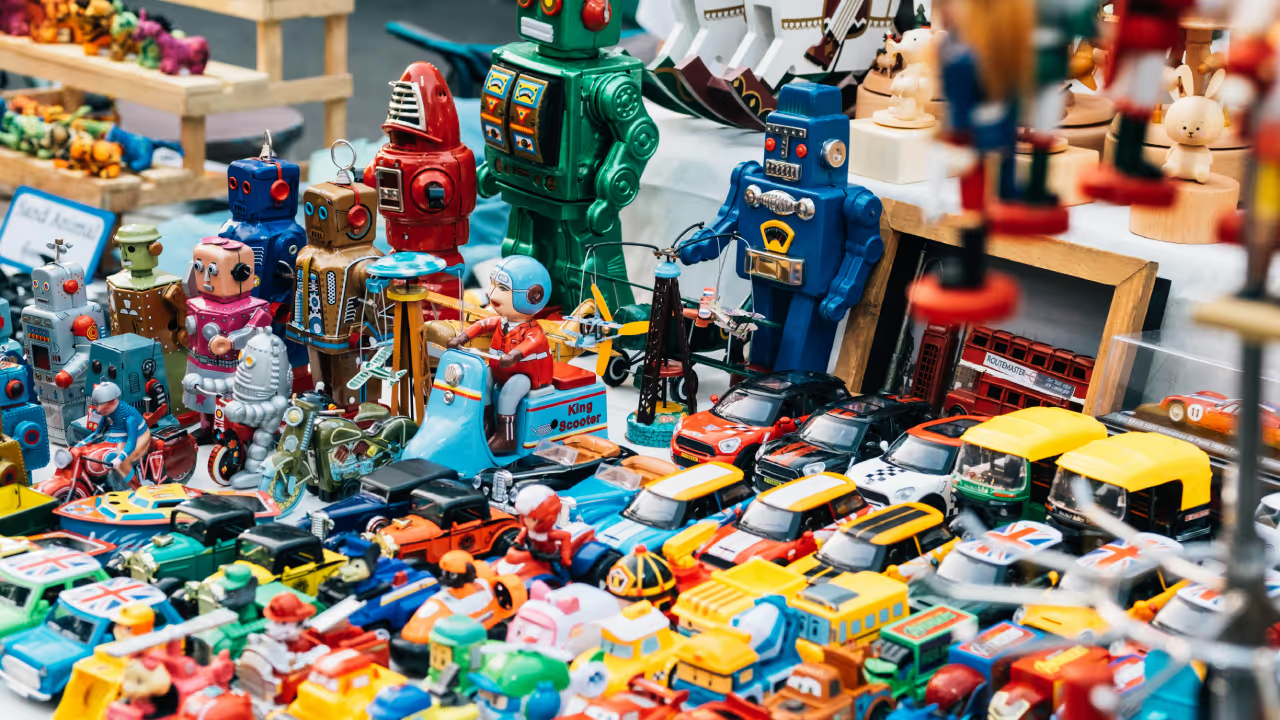
Every December, in the toy aisle, supply chains heave, demand overshoots supply, scarcity juices prices, and consumers swing between cool, calm, and collected, and outright panic. At the centre of it all, the latest plush or plastic doodad that has for reasons no one can fully explain become the nation’s priority.
Speaking to the Weekend Read, Chris Byrne, known as The Toy Guy, put it this way: “A toy craze begins when a toy stops being a great toy and becomes part of a cultural moment.” At that point, it’s no longer just a toy but something we status-obsessed apes use to prove we belong. From there on out, demand is driven not by utility but by FOMO.
Toys have been around forever. Archaeologists have found dolls, figurines and wheeled animals going back nearly 9,000 years, older than many markers of civilisation. While toy manias may be the product of a world of mass media machinery and global supply chain plumbing, all a relatively modern invention, we’ve been mad for toys since day one.
The spring and the rock
The first toy mania was probably the teddy bear in the early 1900s – named for President Teddy Roosevelt – which emerged from a political cartoon and quickly outpaced production.
Another early mania was Shirley Temple dolls in the 1930s, during the Depression – stressed consumers will spend on things that make them feel good. It’s the lipstick effect, the idea that in hard times consumers cut back on expensive purchases but increase spending on small, affordable luxuries like cosmetics, sweets, coffee, and toys.
What constitutes a toy can be stretched quite far. The Slinky became an overnight success in 1945 after engineer Richard James knocked a tension spring off a shelf and noticed it ‘walked’ down. A quirk of physics with no seeming commercial use. But the Slinky has sold more than 350 million units – roughly one for every person in the United States – making it one of the most successful ‘toys’ ever produced.
Perhaps even more bizarrely, the Pet Rock in 1975 – a literal rock – sold more than a million units in six months. Both the spring and the rock demonstrate how a good story and a neat idea can sell faster than anything so vulgar as being useful or necessary.
You. Are. A. Toy!
Cabbage Patch Kids triggered the Cabbage Patch riots in 1983, which saw a number of reported injuries. Byrne explained: “Having the ‘it’ toy tells the world you’re connected to a specific place or time – sometimes even to higher status.” Getting your hands on one, therefore, can become what seems like a matter of life and death. While there have been no reported deaths from consumers trying to get their hands on the latest must-have, the 1996 Schwarzenegger comedy Jingle All the Way remains a surprisingly accurate cautionary tale.
With Tickle Me Elmo in 1996 TV didn’t just show the queues, it created them. Each clip of parents scrapping over Elmo summoned another garrison of shoppers, dutifully marching into the fray. Supply chains, tuned to slower cycles, couldn’t keep up.
And sometimes the panic isn’t just about shortages. When the animatronic toy Furby launched in 1998, it sold out almost instantly ahead of Christmas. But because Furby could ‘learn’ words over time, rumours spread that it was secretly recording conversations. In 1999, the US National Security Agency banned Furbies from their buildings, worried they might pick up classified information. The fears were misplaced as Furby didn’t actually record anything.
Earlier in the decade, the House of Mouse (DIS) expected Toy Story – the world’s first fully computer animated feature – to be something of a sideshow that year, not the seminal hit it became. The studio was banking on the Hunchback of Notre Dame. While Pixar was the creative powerhouse behind Toy Story, Disney was charged with distributing and marketing the movie.
But once its never-before-seen animation style and unexpectedly sharp writing helped turn Toy Story into a breakout hit, demand for Buzz Lightyear toys exploded. Thinkway Toys, a relatively tiny Canadian firm, had produced not nearly enough units – humorously referenced in the 2000 sequel. The whole palaver ended up costing The Walt Disney Company around $50 million in unrealised sales that year.
But nothing captures toy mania better than Beanie Babies. “They stopped being a cute toy friend and were treated like a commodity to be traded and valued,” Byrne said. Byrne remembers people placing Beanie Babies in safety deposit boxes. It was textbook bubble behaviour. When the mania evaporated, so did the value.
Barbara and Joe
The post-war boom saw toys that weren’t fads but shifts in what children played with. Barbie, GI Joe, early action figures, movie tie-ins, and the rise of television advertising, the legacy of which is felt today. Mattel (MAT) and Hasbro (HAS), in particular, have had great success expanding toy lines into entire media ecosystems. That also doubled as soft power in the late Cold War. American toys rode American media into living rooms worldwide, exporting a version of consumer culture without needing to call it propaganda.
For G.I. Joe, Hasbro collaborated with Marvel Comics and Sunbow Productions to create characters and storylines that became the cartoon and comic books. The strategy was highly effective. The associated media drove the popularity of the toys – not the other way around. Hasbro sold more than $51 million worth of G.I. Joe products in 1982 and by 1985 the pint-sized private was the top-selling American toy.
Hollywood learned the same lesson. A toyetic movie or TV show became more likely to be greenlit by studio honchos and TV execs. The latest example is Barbie – the most successful film of 2023, earning over $1.44 billion globally. The second-highest grossing movie of that year was Oppenheimer, at around $975 million.
Slapped it on a plastic lunchbox
Star Wars in 1977 was the first to really lean into movie tie-in action figures, which were smaller than dolls like G.I. Joe at 3 3⁄4-inches (95 mm). Perfect for pockets. George Lucas forfeited his directing fee in exchange for merchandising control, earning the director billions.
Jurassic Park went even further on toys and other merch. The world went dino delulu in ‘93 after the studio spent almost as much promoting the film as it did making it. Universal (CMCSA) signed a record number of licensing deals – more than 100 – covering toys, clothes, stationery, bedsheets, backpacks, sweets, watches, board games, video games, pyjamas, fast food tie-ins, posters, calendars, trading cards, sticker books, and, eventually, theme parks. The move paid off. Jurassic Park is still more than 30 years later one of the most financially successful films of all time.
Empty shelves
There’s a myth that toy makers engineer scarcity to make toys more desirable. But that’s nonsense, Byrne said: “Toymakers never engineer scarcity – that’s a lost sale.” Toys run on tight margins, long lead times and taut retailer relationships, and orders are placed months in advance. No sane toy maker creates an artificial shortage in November when Christmas sales determine annual earnings. Factor in the capricious whims and fancies of children which no model can entirely predict, and a product that goes viral in late November is destined to be scarce. Collectibles are a slightly different beast. Pop Mart’s Labubu line, for example, works more like streetwear or trading cards with controlled drops and blind boxes that ration supply by design.
Once scarcity sets in, pricing power shifts to the secondary market. Byrne noted the days when parents braved the elements in lines snaking round the corner are largely over. Like everything else, it’s all migrated online. Resellers will often buy out shelves and list toys at marked up prices before manufacturers even know demand has spiked.
Made in China
The toy industry relies heavily on Chinese manufacturing. Entire swathes of Guangdong, Shantou and Dongguan specialise in moulding, plastics, electronics, and packaging. Attempts to reshore production to the US or Europe remain unviable. Even alternative Asian locations such as Vietnam, India, and Mexico have not yet replicated China’s cluster efficiency. Toys still pour out of the Pearl River Delta.
Shipping costs, which soared in 2020-21, hit toy margins particularly hard because shipping represents a large portion of unit cost on low-value goods. A $15 toy carried across the Pacific on a container priced at $15,000 is materially different from the same toy shipped when prices are $2,000. These cost swings shape retail prices and sometimes determine whether a line is economically viable at all.
Toys must also comply with strict testing regimes, including CPSIA standards in the US and CE marking in Europe. Compliance functions as a barrier to entry, reinforcing the industry’s reliance on larger manufacturers with the resources to manage such rigorous testing.
Grey market and illegal copies of popular toys – particularly blind-box collectibles and LEGO sets – have become a global business. For LEGO, anti-counterfeit enforcement is now a major expense.
One toy to rule them all
The toy industry is one of the most seasonal sectors in consumer goods. Companies borrow heavily in spring and summer to finance production. Retailers will borrow to finance inventory and cashflow peaks in December.
Many bankruptcies in the toy business occur in late winter and early spring because the mismatch between inventory commitments and realised demand only becomes clear once the season is over. Toys “R” Us collapsed in part because it lost the ability to finance this seasonal working capital cycle while Amazon and Walmart squeezed its margins.
The monoculture hit, the one-toy-to-rule-them-all of the 80s and 90s, has given way to a fractal market of micro-hits driven by TikTok, YouTube (GOOGL), Instagram (META), and Discord. Toys have far more competition for attention, and success now often looks like a long-term niche rather than a single craze. Look at Games Workshop (GAW), a British success and a hobby with particularly deep engagement and repeat spending. Byrne put it plainly: “Toymakers aren’t chasing the big mainstream hit anymore. They’re building niches and encouraging consumers to buy deep in those.”
This fragmentation is also why the kidult market is huge, and growing. Adults, with disposable income and established tastes (DINKS, anyone?), anchor demand in a way finickety children do not. Byrne sees this as a direct response to demographic decline: “More adults are buying toys for themselves. It’s offsetting population decline.”
Authors of magic
As you're settling into your holiday routine, dreading the trip to collect some last minute gifts, thank a powerful cultural marketing engine for the idea of Christmas as ‘toy season’. The link between Christmas and toys only really took off in the 1800s as industrialisation made toys cheaper and middle-class families had more spare cash. By the early 20th century, department stores, catalogues, and marketing engines had turned toy-giving into a ritual. And after WWII, rising incomes and mass advertising locked in the idea that Christmas and toys go hand in hand.
Parents do not panic buy toys because they believe in long-term value, they do it to avoid disappointing a child. “Parents want to be the authors of magic,” Byrne said. “The toy business is the only one I know where success or failure depends on the whims of seven-year-olds.”
As we’ve seen, the toy industry tells us about supply chain fragility, demographic shifts, IP economics, counterfeiting, pricing strategy, arbitrage, forecasting limits and consumer psychology. As items of leisure, entertainment, and play they do not pretend to be rational. They are sentiment incarnate. Everyone had a favourite toy growing up. Toys change, behaviour doesn’t.
Important Information

.png)

.avif)
.avif)

.avif)