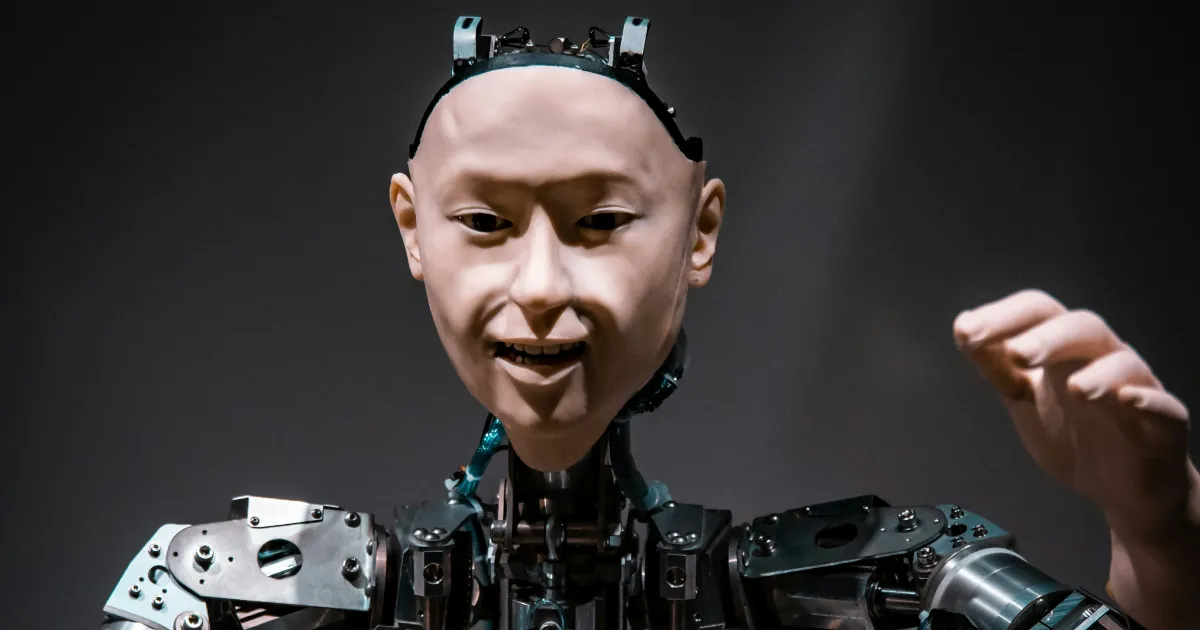
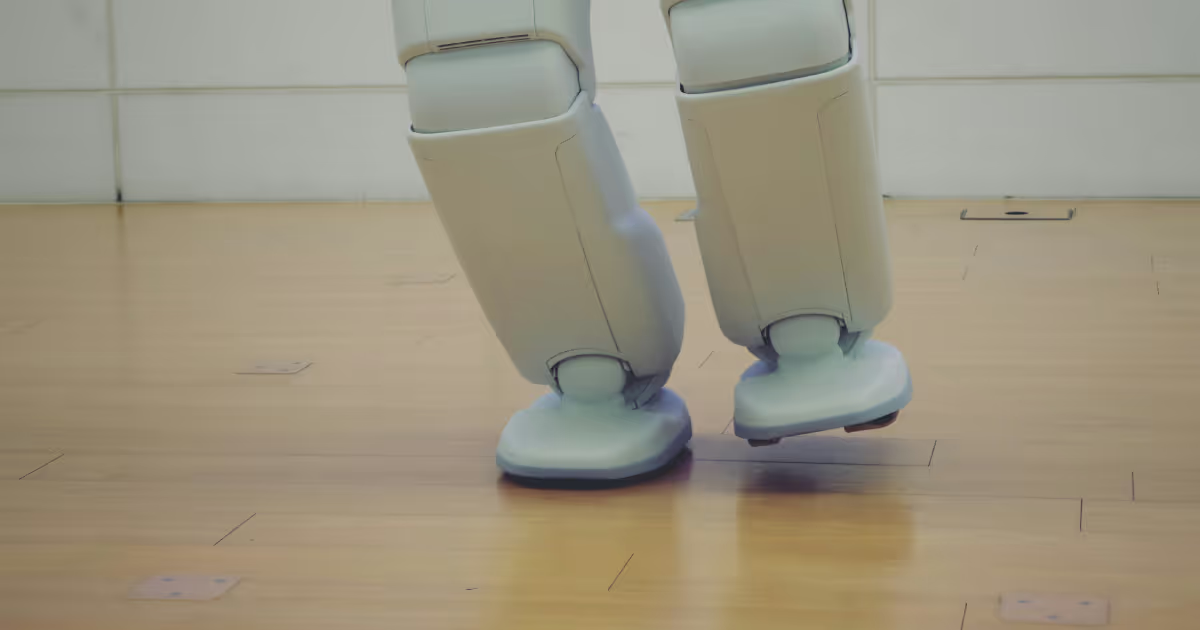
Unlike that other sci-fi staple, flying cars, domestic robots are starting to feel within reach. Big leaps in robotics, artificial intelligence, sensors, batteries, and computing have seen impressive demos in homes and trade shows worldwide. The idea of a robot in every home is so evocative it’s easy to lean on pop culture to tell this story. But much of their impact will be unglamorous – caring for the elderly, propping up services, supporting households.
Culturally, we’re already halfway there. A decade ago it felt weird to talk to your phone. Now, a lot of us talk to invisible software all the time. In 2023, 42% of UK households had a smart speaker. Three-in-ten British adults used digital assistants at least once a day in 2024.
But the home is hostile territory. Domestic robots must navigate stairs, pets, toys, corners, spills, and, of course, humans both big and small. The terrain can change on the regular, whether that’s after a trip to IKEA or the maternity ward. Homes are also multi-user environments. That raises questions around who gets to command the robot. And who’s responsible for it.
Most of the market today is chorebots, such as robot vacuums. A lot of the hype is around carebots, anything involving bodies or health. But the real battleground is home agents, or homebots. Think of a smart home with arms, hardware that you live in.
From the ground up
The International Federation of Robotics (IFR) says consumer robots sold about 20.1 million units in 2024 (+11%), with those responsible for domestic tasks making up 97% of sales. The global smart vacuum market shipped 6.17 million units in Q2 2025, up 20.5% year-on-year. There are also established categories in mowers and pools, led by legacy outdoor brands.
The robot future, therefore, may arrive as a bundle of single-task machines rather than one all-purpose humanoid. Chorebots work because they do one very narrow job reasonably well. That’s much easier to design. And if it fails, it’s not the end of the world. But as soon as a robot starts doing anything that can break things (or people!), that’s a whole different ball game.
As soon as a robot is operating close to humans, safety becomes paramount. The International Organisation for Standardisation (ISO) has already set standards for different classes of robots, establishing the regulatory foundation for their development. In 2014, ISO 13482 outlined safety requirements for personal care robots, including mobile servant robots and physical assistant robots – the first of its kind.
Warehouses – where many robots live and work – have smooth floors, controlled lighting, standardised shelves, and trained humans. Homes are the opposite. Each one is a bespoke obstacle course. A demo robot only has to work once and under supervision. A home robot has to work every day, home alone. And one thing that doesn’t show up in demos is upkeep. With chorebots, it’s emptying docks, cleaning brushes, replacing filters, wiping sensors, and dealing with the occasional software wobble. No doubt there will be a battery of new asks and tasks associated with the domestic robots of the future.
Arms dealers
Domestic robots are already a real market, made up of device makers and the companies selling chips, models, and tooling. Winners in the robot vacuum space are mostly Chinese brands, such as Roborock, Ecovacs, Dreame, Xiaomi and Narwal.
The transition from a robot that cleans floors to a multi-purpose robot that helps around the house is a huge leap. Which is why most of the serious humanoid work is coming from firms that can either manufacture at scale or build the ‘robot brain’. Tesla (TSLA) is the obvious scale bet. Figure is the other. Helix is Figure’s vision-language-action approach to getting a humanoid to follow natural language instructions and handle unfamiliar household objects.
Industrial humanoid firms are proving out humanspace. Agility Robotics is running Digit in live warehouse environments, doing repetitive tasks. Apptronik is piloting its Apollo humanoid in Mercedes-Benz manufacturing facilities.
At the higher-end, Boston Dynamics has paired its Atlas platform with Google (GOOGL) DeepMind’s Gemini Robotics models, stretching humanoids beyond pre-scripted moves. Behind them all sit the ‘picks and shovels’ players. Nvidia (NVDA) is flogging a software and simulation stack for humanoids – Isaac GR00T N1 – so more companies can focus on the brawn, not the brain.
That brawn is made up of actuators, motors, gearboxes, sensors, and power management and safety systems. All that specialised tech is why automotive companies are a big part of this story. Cars are already mass-produced electromechanical systems. A lot of the capability for humanoid robots will likely come from the industrial base that builds vehicles.
Humanoids are not inevitable. They’re one of many design choices. The classic wheel is cheap and stable. Legs, meanwhile, are expensive and complicated. Hands are hard. Most household tasks don’t actually need a human body. That’s why the near-future probably looks like lots of semi-robotic helpers. A vacuum here, a mower there, maybe a small arm on a base for narrow jobs. More R2D2 than C3PO.
Help wanted
Domestic robots will be tasked with tackling problems associated with ageing, care, and labour constraints. Currently IFR’s numbers for the category robots for care at home recorded only 536 sales in 2024. The UN puts the global 65+ population at 1.5 billion by 2050. That’s one-in-six worldwide. WHO puts the 60+ population at 2.1 billion by 2050, with the 80+ group tripling to 426 million. Combine that with a projected global shortage of 11.1 million health workers by 2030 and the potential market for carebots is absolutely massive. But care sells through institutions and institutions move slowly.
Japan is ageing fast, and it has been pretty explicit that it wants technology, including carebots, to help plug the gap as there aren’t enough workers. Japan’s trade and industry ministry, as well as its health ministry, have outlined a set of priorities for using robots in long-term care. That doesn’t mean Japan has no migration. Its foreign workforce hit a record 2.3 million as of October 2024. But the country’s policy has long been to use automation alongside tightly managed immigration, rather than assuming the care system can be staffed indefinitely from abroad. Compare that with the UK where adult social care has become dependent on overseas recruitment.
Labour politics
The politics of work will be unavoidable because a lot of technology is inherently labour-saving. That’s kind of the point. We’ve seen this before. Mechanised looms and spinning machines reduced the need for skilled textile labour. Tractors and combine harvesters pushed whole economies out of agriculture. In offices, the spreadsheet replaced manual ledger work. ATMs cut the need for routine cash-handling. In factories, industrial robots took over the most repetitive and dangerous tasks such as painting and welding.
Management framed these advances in robotics as enhancing safety and productivity. Workers worried about getting fired, and getting paid. Both can be true at once. A carebot might genuinely reduce back injuries and night checks. But it could still be used to stretch fewer carers across more people, holding down wages, juicing the effective supply of labour.
The word robot comes from the Czech robota – forced labour – coined by Karel Čapek’s play R.U.R., a story about manufactured workers. Robots are pitched as ‘helpers’, but we’re still talking about labour. Once robots move beyond narrow chores and start working among us, as they become more autonomous, the debate around their rights and legal status will be hard to ignore.
Everyday exposure to robotkind in the home, school, and hospital may spur human empathy towards our mechanical friends. Or their presence could be divisive, as robots put hundreds of millions out of work. Perhaps there will be an industry-wide set of rules, in the vein of Asimov’s Three Laws of Robotics, to ensure safety, reliability, and harmonious human-robot relations. The European Parliament has already floated ideas on this in work on civil law rules for robotics.
OK, computer
In August 2022, Amazon announced plans to acquire iRobot for $1.7 billion. The move triggered intense antitrust scrutiny in the US and Europe over data privacy and monopolistic concerns. The deal was terminated in January 2024 after regulators signaled they would block it. Following the collapse of the deal, iRobot faced significant financial trouble, laying off 31% of its staff and ultimately filing for bankruptcy in December 2025.
Mapping your home isn’t just geometry, it’s a model of your life. People may end up managing their most intimate environments in different ways to allow robots to do their job more efficiently. Will the disorganised feel judged by domestic robots in their cluttered homes, in a kind of Dickian paranoia? If one company becomes your home OS, it will have a privileged view of your life and the ability to nudge your behaviour in subtle yet profound ways.
A robot that is genuinely helpful needs to know where you keep things, what you buy, what time you wake up, whether you’re home, who else is home. All valuable data, all very intimate. Where does that data live and who controls it? Can you delete it? And a hacked vacuum, while annoying, is a different beast to a hacked home. Then there’s the recurring revenue. Platforms love recurring revenue. They’ll want subscriptions, add-ons, marketplaces, upgrades. People hate vacuuming but will they pay a subscription to avoid it?
For now, most of the money is still in narrow bots doing narrow jobs. To get from ‘single-task appliance’ to ‘general home agent’, firms will have to navigate standards and safety, returns and repairs, and the dull reality of supporting millions of devices in messy homes.
The value of your investments can go down as well as up and you may get back less than you invest.
Freetrade does not give investment advice and you are responsible for making your own investment decisions. If you are unsure about what is right for you, you should seek professional advice.

.webp)