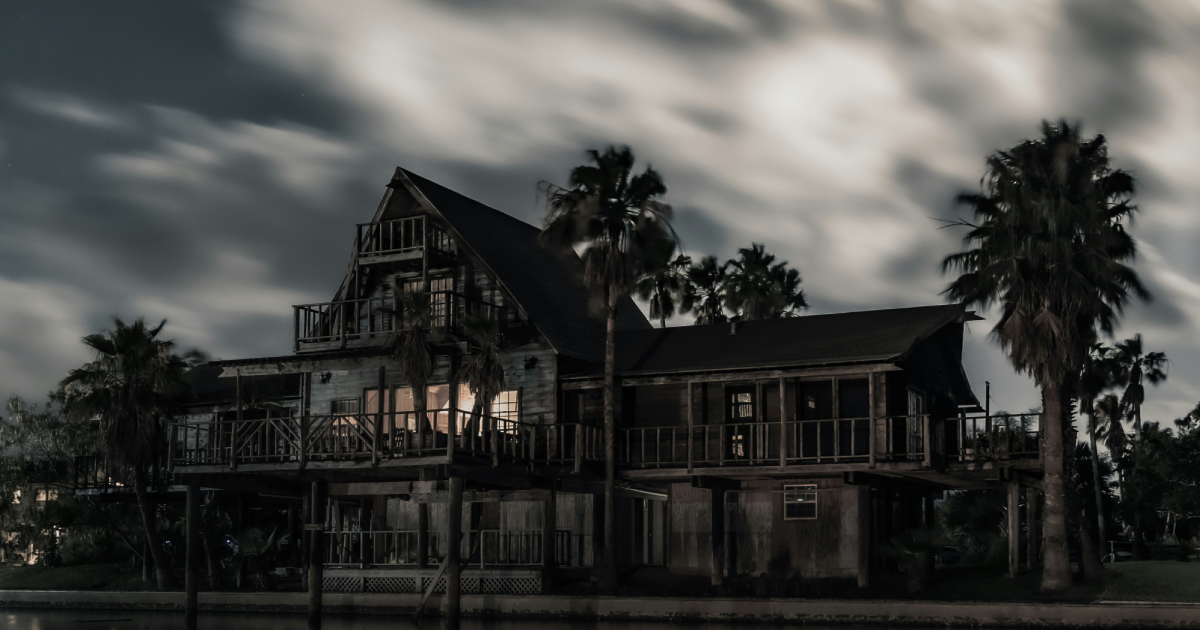
In 1989, New Yorker Jeffrey Stambovsky was set to buy a Victorian house at 1 LaVeta Place in Nyack, a village on the Hudson River. The price was $650,000 and he paid a $32,500 deposit. But the property had a bit of a reputation. Owner Helen Ackley had talked up ghosts in the house for years. When Stambovsky found out, he tried to cancel the contract and get his deposit back. A lower court ruled against him.
But in July 1991, New York’s Appellate Division reversed the decision. The reasoning was that the property’s reputation could affect what it was worth. An out-of-towner had no reasonable way of finding out about its allegedly haunted past. Because Ackley had publicised the ghosts herself, the ruling concluded “as a matter of law, the house is haunted”, and allowed Stambovsky to cancel the contract. The case is taught in US law schools to this day.
Unfinished business
The idea a violent death can linger is old and widespread. In Chinese folklore, people who die suddenly or unjustly can become restless spirits, unable to move on. Japan has yuurei, lingering spirits of those who died violently or alone. In the West, ghosts are said to have ‘unfinished business’, binding them to a place because their lives ended before their time.
Some paranormal researchers suggest buildings can ‘record’ traumatic events and replay them, an idea popularised by the 1972 BBC drama The Stone Tape. For the related but distinct phenomenon of poltergeists, please refer to the 1982 film Poltergeist. Parapsychologists report that poltergeist activity tends to centre on a person rather than a place, so the haunted take their spirits with them when they move. Good news for buyers: no nasty surprises on move-in day.
Hongza
A study by researchers at the Hong Kong University of Science and Technology calculated the cost of a haunting. In Hong Kong, belief in feng shui is widespread, and many believe an unnatural death leaves behind negative energy. Haunted flats even have their own name, hongza. Hong Kong housing is dense, with many cookie-cutter flats in the same estate, which makes comparisons easier. And the data was reliable, with researchers using records from Hong Kong’s Coroner’s Court.
In the study, a flat counts as hongza if a suicide, murder, or fatal accident happened there. The researchers identified 1,032 haunted flats and analysed more than 1.1 million transactions. After controlling for size, age, long-term price trends, and seasonal demand, they found that a flat lost 19.9% of its value once it was considered haunted. The type of death mattered too, with murder having the largest effect and discounts reaching around 34%.
Ghost town
The more unusual finding was that prices fell across the surrounding buildings too, shrinking with distance. Flats on the same floor lost 9.7%, and those one to three floors above or below fell 8.9%. Elsewhere in the same block, prices fell 7.1%, and across the wider estate the drop was 1.4%.
Neighbouring prices fell even when the haunted flat itself wasn’t sold, so it wasn’t just owners rushing to offload. The researchers concluded buyers simply thought less of homes near a haunting. And the discount persisted. Over the 16-year sample, prices of hongza showed no sign of recovering.
Taiwan has its own version, xiongzhai, and ghosts are taken seriously there. In a 2024 Pew survey, 85% of Taiwanese adults said they believe in unseen beings such as deities or spirits, the highest share in East Asia. Sellers must tell buyers if a home is a xiongzhai, which the law treats as a defect, and there are online forums to identify them and a Facebook page for trading them. Not every court is sympathetic, though. In one case, a judge threw out a landlord’s claim after a tenant’s suicide, ruling the house was not damaged, nor was its use as a home affected.
Jiko bukken
Japan’s term for these homes, jiko bukken, is usually translated as ‘incident property’ or ‘stigmatised property’. It covers homes where a previous occupant died from suicide, murder, fire, or neglect. Discounts are typically 10% to 30% below comparable properties. They can be steeper. The site of a murder may sell for as much as 80% below market value. It may not sell at all. Banks can also value a jiko bukken lower and lend less against it.
Japan had no national standard on disclosing deaths until October 2021. Now, estate agents must disclose suicides, murders, and deaths from fires, as well as any natural deaths where the body went undiscovered long enough to need specialist cleaning. Buyers and renters also do their own research. The main tool is Oshimaland, a free crowdsourced map launched in 2005 by Teru Oshima, which lists reported deaths by address.
Kodokushi
Kodokushi, or ‘lonely death’, describes people who die alone and go unnoticed, often for some time. When Japan compiled national figures for the first time, it found more than 76,000 people died alone at home in 2024. Many of the homes where this happens become jiko bukken, and their number is growing.
That has created its own insurance market. ‘Solitary death insurance’ pays landlords for specialist cleaning, clearing the tenant’s belongings, and rent lost while the flat sits empty. There were 2,220 payouts between March 2023 and March 2024, four times as many as a decade earlier, and the average landlord loss per case was about ¥1.13 million ($7,100).
Fearing a jiko bukken, some landlords now refuse to rent to older people who live alone. Some local governments have stepped in. Since 2022, Nagoya, capital of Aichi Prefecture, has paid landlords’ insurance premiums when an older person moves in on their own. Attitudes to jiko bukken appear to be softening as housing costs rise. A 2025 survey found more than half of respondents would consider living in a jiko bukken if the price was right, and there are agencies that buy, clean, and relist these properties at a discount.
Caveat emptor
In England and Wales, there is no legal requirement to disclose that a house is believed to be haunted. Property sales follow the principle of caveat emptor, or ‘buyer beware’. But sellers must answer buyers’ enquiries honestly. Estate agents are held to a higher standard(!). Under consumer protections, they must share ‘material information’ that could affect a buyer’s decision. Whether a ghost counts as ‘material’ is up for debate. One online estate agent, House Network, even launched a ghost-free certification service for nervous sellers.
In 2018, statistician Geoff Ellis looked at 25 British ‘haunted houses’ sold over the previous half-century and found they went for an average of 17% less than similar homes. It’s a small sample, but unlike most UK figures, it’s based on actual sale prices. Estate agency Yopa estimated that a haunted home could sell for around 10% less, and found only a quarter of sellers would admit to a haunting. At the extreme end, some homes become unsellable. 25 Cromwell Street in Gloucester, where Fred and Rose West committed their murders, was demolished in 1996 and replaced with a footpath. Grim.
Amityville
In the US, the rules vary. In many states, sellers don’t have to disclose that a death occurred in a property. But in California, a death on the property within three years of a buyer’s offer must generally be disclosed, while an older one doesn’t. If a buyer asks, the seller has to answer truthfully, however long ago it happened.
America’s most famous haunted house is in Amityville, Long Island. In 1974, Ronald DeFeo Jr. murdered six members of his family at 112 Ocean Avenue. The Lutz family bought the house the following year but left soon after, claiming it was haunted. Their story, which has been widely questioned, became the best-selling book and 1979 film The Amityville Horror.
Later owners went to great lengths to make the house harder to find. The address was changed to 108 Ocean Avenue, and the property’s distinctive quarter-moon windows, the film’s signature image, were replaced. In 2017, the house sold for $605,000, well below its $850,000 asking price.
They’re here
The property at 30 East Drive in Pontefract looks like any other former council house. But since the Pritchard family moved in in 1966, it’s been notorious for a poltergeist called the Black Monk, dubbed the UK’s most terrifying ghost. Unusually for a poltergeist, it seems to have stayed put. The semi stood empty for years but now attracts devotees of the strange and unusual.
After making a horror film about the house, producer Bil Bungay bought it for £80,000 in 2012 and now charges punters up to £400 to spend the night. Demand is such that there’s a two-year wait, even though Bungay tells visitors they won’t be covered by insurance, and he doesn’t recommend it. A haunted house that’s an easy sell, for one night at least. People like haunted houses. They just don’t want to live in one.
The value of your investments can go down as well as up and you may get back less than you invest.
Freetrade does not give investment advice and you are responsible for making your own investment decisions. If you are unsure about what is right for you, you should seek professional advice.