
This week’s earnings preview features one of the AI boom’s standout performers, and one of the biggest names in high-end yoga pants.
We’ll start with the tech revolution, exploring whether Broadcom and Snowflake can continue translating AI enthusiasm into accelerating growth. Then, it's the turn of two very different retailers. Five Below is riding high as its trend-led treats prove a hit, while Lululemon needs a turnaround as new product launches fail to land. Read on to get the full lowdown.
Note: All estimates are based on data provided by Refinitiv.
Broadcom - Gangbusters
Earnings release: Wednesday 2 September, after market close
Revenue estimate: $29.36bn
EPS estimate: $3.24
Broadcom looks like one of the early winners from the AI infrastructure boom. Its chips and networking gear keep modern computing systems running, and it also has a foothold in VMware software that allows corporate customers to run sprawling empires of virtual machines and IT infrastructure from a single platform.
Back in Q2, net revenue leapt by 48% year-on-year (YoY) to $22.2bn, while net income soared by 88% to $9.3bn. The fuel behind the surge, the coal being shovelled into the engine, is of course AI semiconductor demand.
Semiconductor revenue from AI was 143% higher at $10.8bn. For Q3, the business has its sights on over 200% YoY growth from the segment, up to $16.0bn, and says demand visibility extends into 2028.
Broadcom’s headline numbers might look extraordinary, but adjusted gross margins have dipped, falling by 230 basis points YoY due to the runaway growth of its lower-margin semiconductor segment.
Broadcom projected a continued decline, down to 74% in Q3, as semiconductors’ prominence in the product mix grows.
But as long as income and revenue are still going gangbusters, will investors really care? Just because it appears to be a negative signal, it’s not necessarily a reason to chuck their toys out the pram. Context is king.
That’s not to say there aren’t warning signs worth looking out for.
Last time we covered Broadcom’s earnings, we cautioned on customer concentration as the business’s rapidly growing Semiconductor segment is heavily reliant on just a few big spenders.
Last month, we saw some poking at that sore.
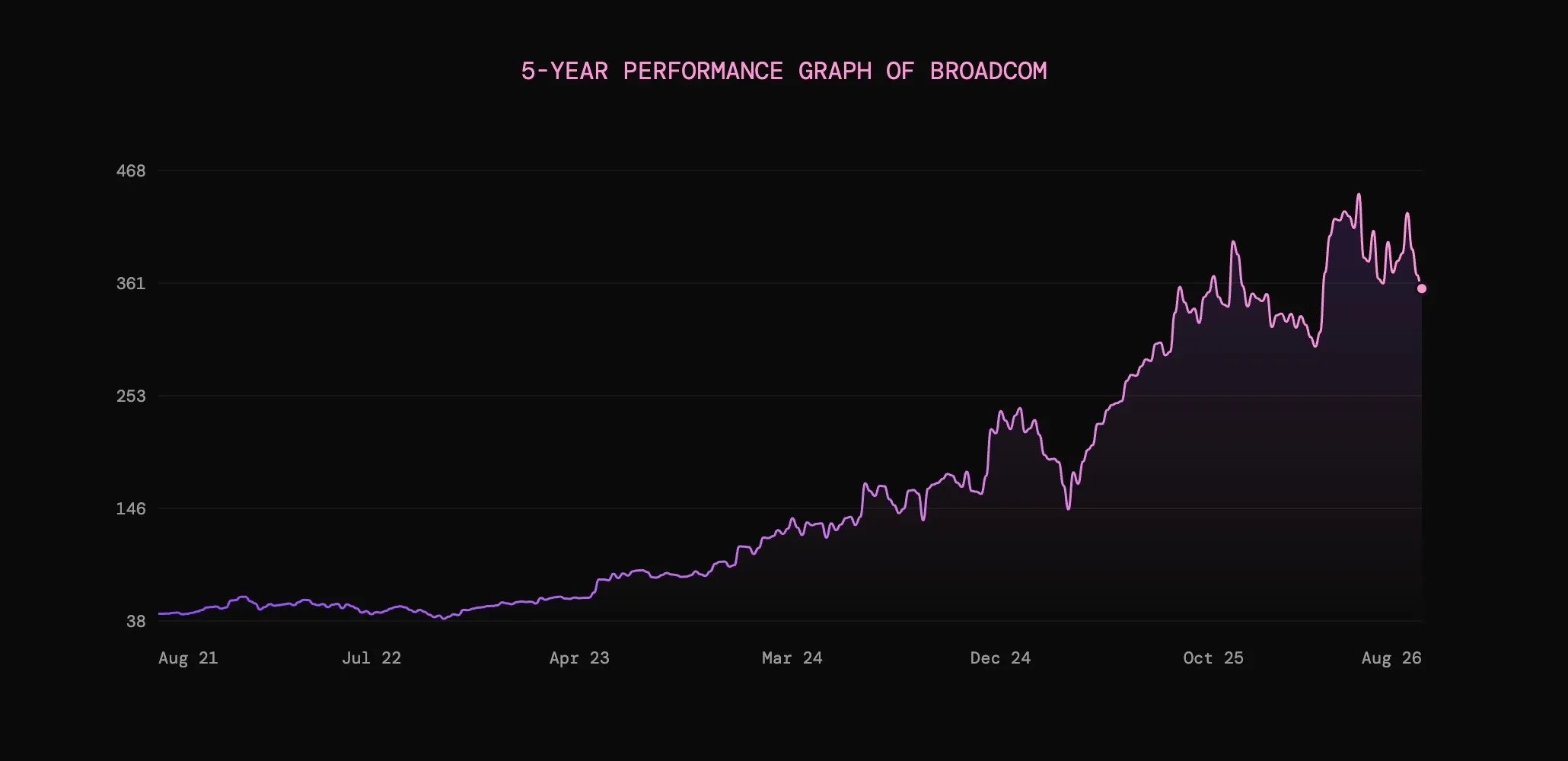
Key customer Alphabet expanded a custom silicon partnership with rival chipmaker Marvell Technology, covering tech for its tensor processing unit (TPU) ecosystem. This might not quite be a case of Broadcom being the ghost at the feast, but it has made some investors reevaluate the depth of its relationship with a key customer. In response, the share price dipped by around 5%.
Investors may want to see some more customer base diversification, or firming up of existing hyperscaler relationships. Broadcom claims to offer “vastly superior technology and execution” to rival firms, but will that keep it hurtling along through the AI buildout?
Snowflake - Let it snow
Earnings release: Wednesday 2 September, after market close
Revenue estimate: $1.48bn
EPS estimate: $0.45
With the summer’s heatwaves fading into memory, we’re turning our attention to Snowflake. Snowflake caters to businesses that want data sorted, interpreted, or just stored. Its platform allows customers to purchase credits and spend these on a pay-as-you-go basis as they pick and choose the right solutions for their data needs.
For investors, revenue is at the forefront of the Snowflake story.
Q1 saw the business raise full-year product revenue guidance, having seen it rise by 34% YoY to $1.3bn during the period. New users are flooding through the doors, with net new customers up by 38% in Q1, as Snowflake claimed businesses are turning to its platform for data and AI led transformations.
But the new guidance? Snowflake now expects 31% product revenue growth across 2027, up from 27%, and 30% growth in Q2. Given the recent acceleration, that might sound a little underwhelming, cautious even.
Perhaps that’s because Snowflake’s growth story has not been smooth, with YoY product revenue growth sliding from 83% in Q2 FY2023 to 33% in Q4 FY2024 and never really pushing on from there.
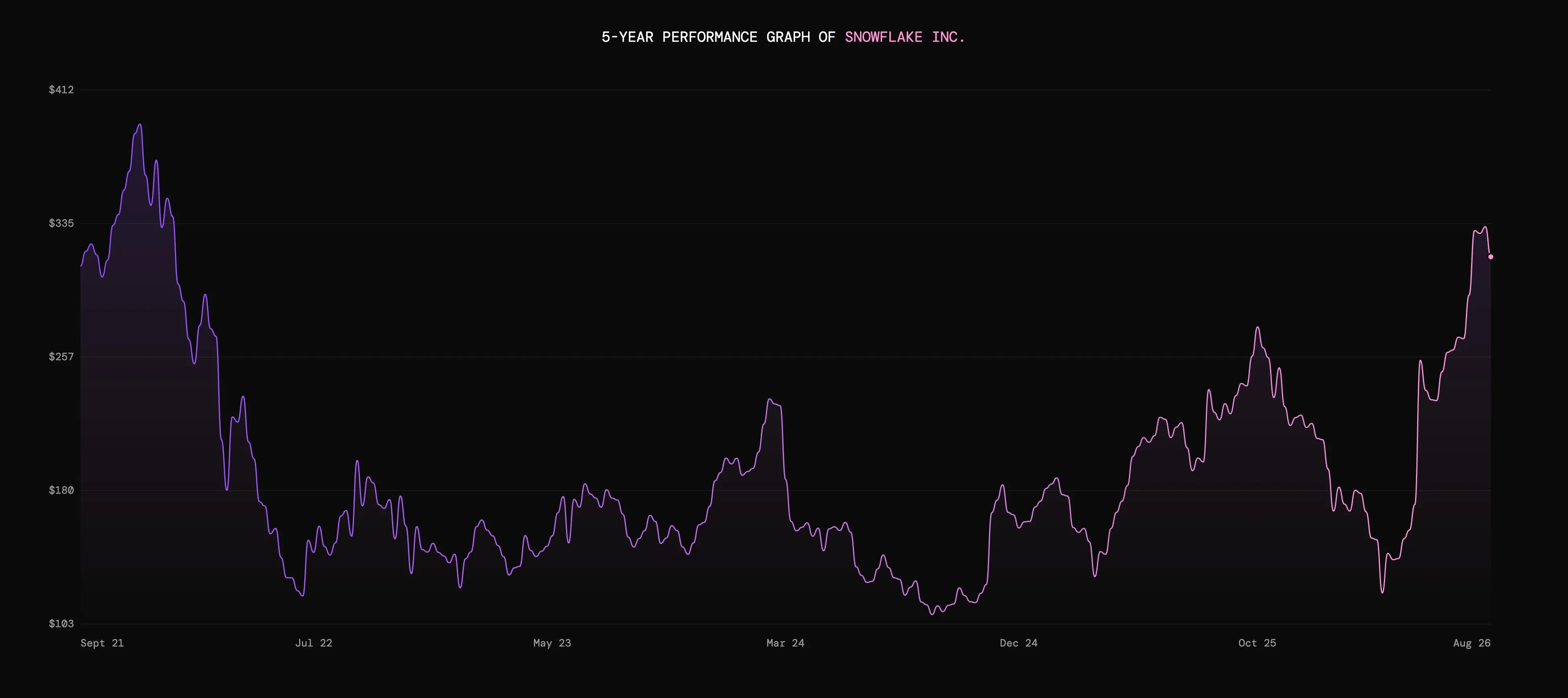
But, even with Snowflake’s caution, Q1 seems to have galvanised investor confidence. Snowflake’s share price has staged a remarkable recovery this year, bouncing back from lows of around $120 in April to over $330 at the time of writing.
This kind of aggressive rerating of the stock has likely raised the stakes. Investors will also want evidence that the business’s lean into AI is changing how customers spend.
As we’ve already noted, Snowflake appears to have made a key growth driver out of helping businesses get their data ducks in a row as they look to leverage AI.
A further step in the right direction would be more evidence that Snowflake’s own AI-native products, like Snowflake Intelligence, are proving a hit with customers. With net revenue retention rate at 126%, meaning existing customers are spending considerably more than during the same period a year ago, stronger adoption of Snowflake's AI tools could help push that figure higher still.
So, can Snowflake bolster investor confidence with another quarter of revenue acceleration, or will the hype melt away once more?
Five Below - Cheap tricks?
Earnings release: Wednesday 2 September, after market close
Revenue estimate: $1.22bn
EPS estimate: $1.38
UK investors might not have heard of Five Below. After all, the business doesn’t have any presence on this side of the Atlantic, or indeed outside of the United States. So, for those not in the know, Five Below is a low-cost retailer with a focus on toys, tech, decorations, sweets, and pretty much any other trending product it can jump on and promote through its social and digital channels.
Think Kpop Demon Hunters keychains, Pokemon backpacks, and Mickey Mouse pyjamas. It’s almost as if the concept of an impulse buy was turned into an entire retail chain.
It might not sound flashy, but it's a concept that really delivered the goods in Q1. Net sales leapt by 32.5% YoY to $1.3bn, with comparable sales climbing by 22.7%, while net income roughly tripled to $123.1m.
With transactions up by 19% in the period, it seems new customers are driving revenues higher rather than higher prices. Meanwhile, those strong comparable sales, coupled with new distribution efficiencies, helped adjusted gross margin to soar by 340 basis points to 37.2%
Understandably, this performance caught investors’ attention.
Keeping expectations in check, Five Below guided for Q2 comparable sales growth of between 7% and 9%, with net sales between $1.18bn and $1.20bn. It's possible we shouldn’t anticipate a rerun of Q1’s explosive growth.
The business seems, after all, heavily exposed to crazes and customer whims. For example, in Q1 it noted that the trend for collectibles and squishy toys was a major driver, while it also jumped on opportunities such as the 30th anniversary of Pokémon.
Today’s crazes and trends will inevitably fade, so the question for Five Below is whether it has the capability to repeatedly spot tomorrow’s. If it can stay ahead, its social media storytelling and expanding footprint appear to stand it in good stead to piggyback on the next big thing.
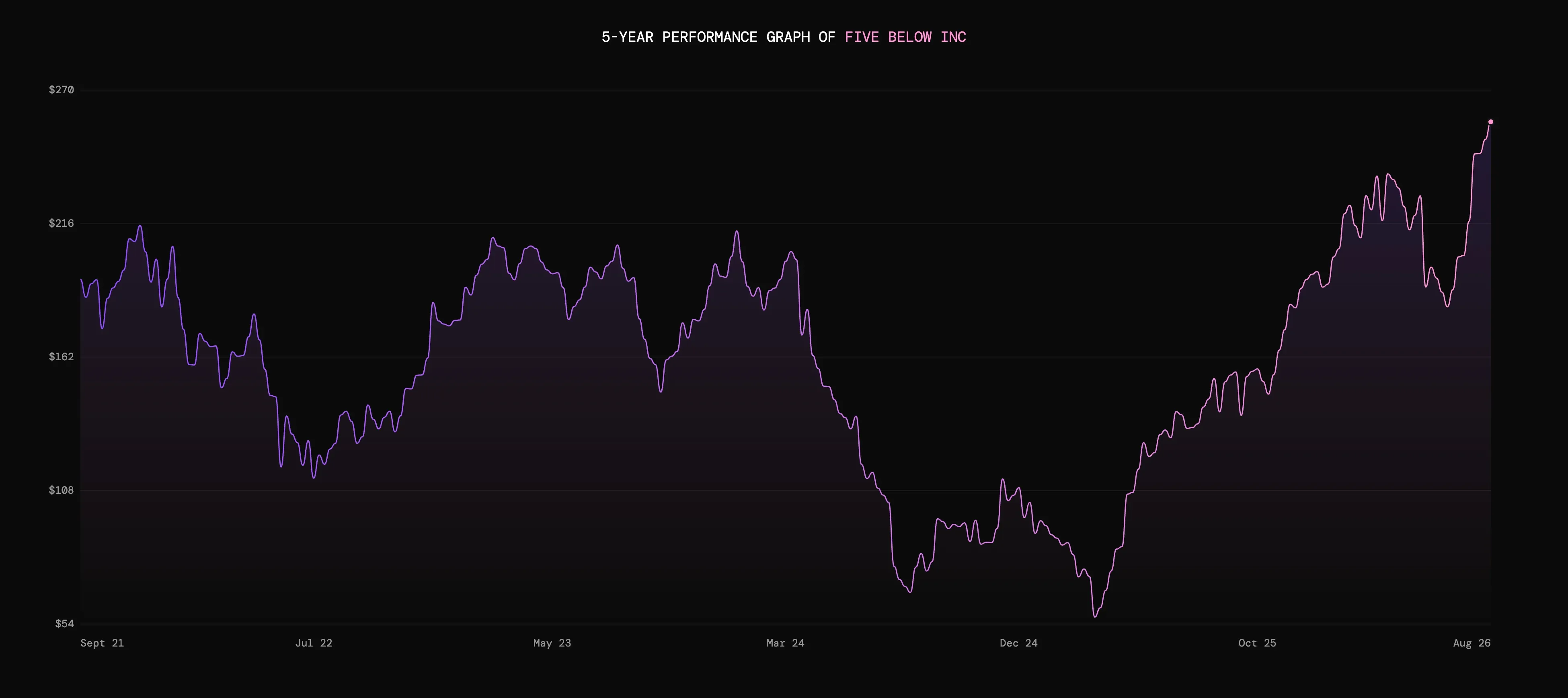
However, Five Below may find it tricky to replicate the success of Q1 if it isn’t able to pinpoint the opportunities offered up by the zeitgeist. Given a roughly 30% rise in share price across the year-to-date and consequent elevated shareholder expectations, it faces some pressure to keep up the pace of sales.
There are other risks to contend with too. Chief among them is the business’s reliance on cheap imported merchandise, which leaves it particularly exposed to tariffs. With prior guidance having assumed a return to higher import tariffs, Q2 earnings could shed more light on how this will impact margins going forward.
However, the overriding question remains whether Q1 was a flash in the pan, or whether Five Below landed on a truly special formula.
Lululemon - Downward dog
Earnings release: Thursday 3 September, after market close
Revenue estimate: $2.46bn
EPS estimate: $1.79
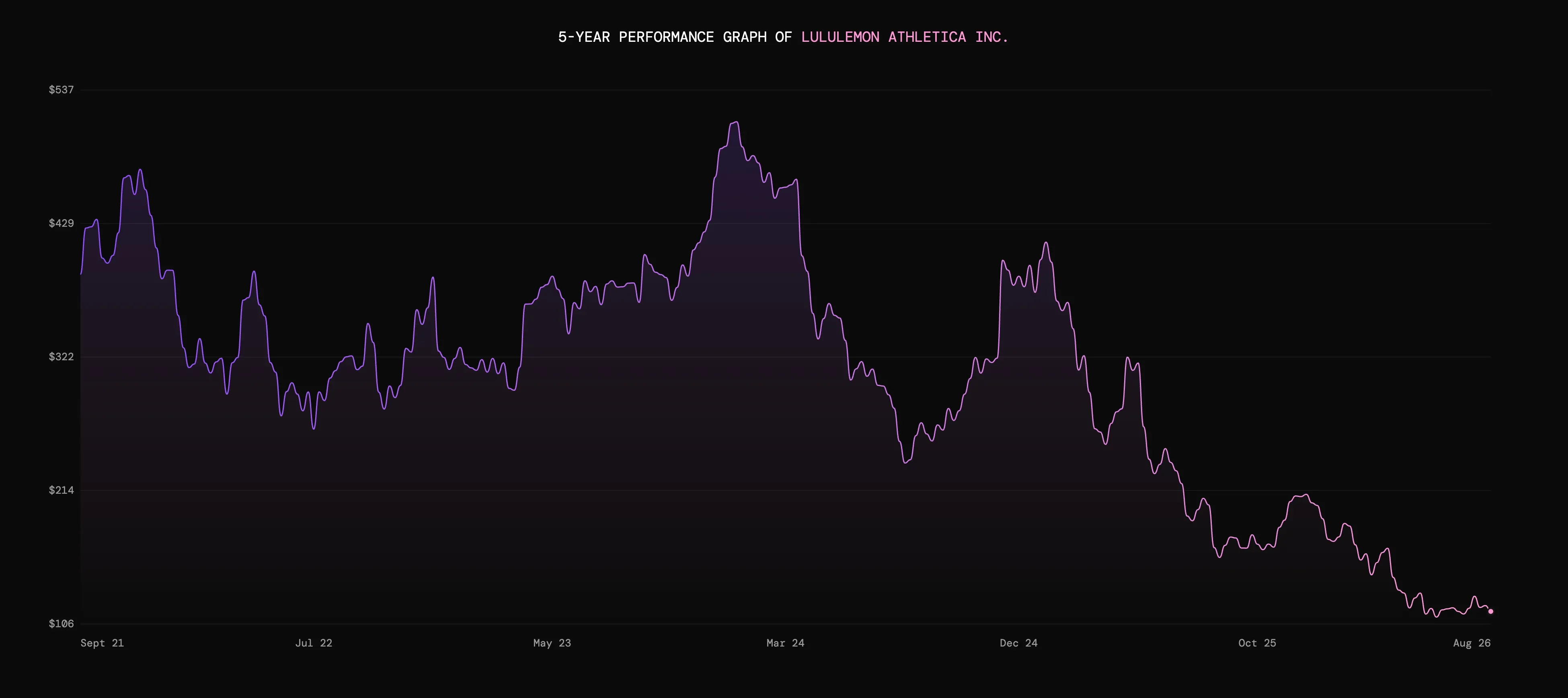
Times are tough for Lululemon investors. The share price is loitering around five-year lows as growth concerns persist around the once-fashionable activewear brand. So, what does the business need to do to hike up its yoga pants and return to smooth sailing?
Let’s start with the numbers. Net revenue might have crept 4% higher YoY to $2.5bn in Q1, but net income slid from $314.6m to $195.0m. Margins are under considerable pressure, with gross margin dropping 410bp to 54.2% as tariffs on imported products take a heavy toll and discounting of unsold merchandise deepens the damage.
The former might be a problem largely outside Lululemon’s control, but the latter shows the key snag. Lululemon’s products have not all resonated with customers. In its Q1 earnings call, interim co-CEO Meghan Frank acknowledged some launches in the period did not “generate the anticipated guest response”.
Commentary here could be key. Lululemon was something of a trailblazer in the activewear space, and both its customer loyalty and employee culture have been referred to as cult-like. But a more and more crowded competitor landscape seems to have taken some of the gloss from its premium leggings.
So sales are struggling to move higher and profits are being sliced away, but regional performance can give us real insight into where the problems and opportunities lie. While Americas revenue dipped by 3% in Q1, sales in China actually leapt by 30% to $478m, counterbalancing some of the lost momentum in Lululemon’s largest market.
This means a slip in the Far East could do real damage, particularly as revenue from the Americas is expected to decline by double-digits in Q2. However, if China can do enough heavy lifting, it may buy leadership more time to execute a turnaround strategy.
And we might need to wait a little to hear more concrete details about strategy. Incoming CEO Heidi O'Neill doesn’t begin her reign until 8 September, so the Q2 report will give us a picture of the state of the business she is inheriting rather than explicit next steps under her leadership.
Will the share price be doing Downward Dog, or is Lululemon going to arrange itself into Warrior I and convince investors the fightback is on?
Capital at risk. The value of your investments can go down as well as up and you may get back less than you invest.
Fluctuations in foreign exchange rates may affect investments denominated in currencies other than GBP and the amount you receive back.
Past performance is not a reliable indicator of future returns.
Freetrade does not give investment advice and you are responsible for making your own investment decisions. If you are unsure about what is right for you, you should seek professional advice.
.webp)
.webp)
.webp)

.avif)

.avif)