.webp)
Freetrade users held firm with familiar favourites in July, as Nvidia retained the top spot and all 10 of the previous month’s most-bought stocks stayed in play.
This gives us a chance to examine why investors might have continued buying SpaceX despite its sharp post-IPO decline, and what sustained demand for AI-related stocks could suggest about investor behaviour.
Remember that this list is not meant as investment advice. Instead, it is simply an insight into the most popular stocks on Freetrade right now.
Top traded stocks methodology: The rankings are based on the total executed value of buy orders placed by Freetrade customers from 1 July to 31 July 2026. The figures reflect buy-side activity only and do not account for sales, holding periods, or individual portfolio weightings.
Post-hype
Following the company’s record stock market debut, the investment narrative around SpaceX has felt pretty negative in July.
For example, some articles have focused on how once enthused investors feel like right numpties now that the company’s share price has fallen by over 50% from highs it reached in its IPO aftermath.
-SHARE-PRICE-PERFORMANCE-GRAPH.webp)
Having been so hyped, and with the central figure of Elon Musk being so controversial, it is perhaps unsurprising that plenty of commentators have been keen to highlight the other side of the coin.
For their part, Freetrade users don’t seem to have been particularly unnerved. The stock maintained its position as the sixth most popular stock in July, and the value of buy orders far outstripped sell orders.
Perhaps they have their sights set on the long-term. After all, a certain degree of share price volatility is to be expected following an IPO. Enthusiasm settles and the market attempts to agree on an appropriate valuation, while the expiration of lock-up periods for employee shareholders can lead to patches of profit-taking.
But what about the actual numbers?
Well, SpaceX’s debut earnings were released after the market closed on Tuesday 4 August. Of course, this was too late to influence July’s rankings, but it still offers an indication of the company’s longer-term prospects.
Headline numbers are certainly eye-catching.
Q2 revenue beat expectations as it leapt by 92% YoY to $7.81bn, with Starlink remaining the key profit engine. On the back of this, the company’s net loss narrowed from roughly $1bn to $541m.
However, the company’s huge AI spending dominated initial market reaction.
Total capital expenditure reportedly reached approximately $18.4bn, including $15.8bn directed towards AI infrastructure. This is around 39% above expectations and makes the cost of realising the company’s spacefaring ambitions hit home.
Will heavy spending, or the company’s stonking valuation, discourage Freetrade users from investing so heavily in SpaceX in August? You’ll have to wait until next month to find out.
Unrustled for now
The market might have wobbled, and some commentators might be spooked, but this month’s top stocks seem to show Freetrade users’ jimmies remain distinctly unrustled.
That’s because they are still heavily buying into the artificial intelligence ecosystem.
It remains the strongest common thread running through this month’s rankings, and indeed the last few. Of course, it’s not like users are just betting on one corner of the boom.
Nvidia, Micron, and AMD offer exposure to different pieces of AI infrastructure. Nvidia has its accelerators, Micron is all about the memory needed to handle demanding workloads, and AMD offers processors and data-centre chips.
Alongside them are some of the companies writing the biggest cheques for their share of that high-powered hardware.
Microsoft, Alphabet, Amazon, and Meta are building data centres, developing their own chips, and expanding the cloud platforms through which many businesses access AI tools.
This means seven of the top 10 are positioned on either side of the same spending cycle.
This highlights a concentration risk. We may have 10 separate stocks, but their fortunes are increasingly tied to the same infrastructure boom and the belief that enormous AI investment will eventually generate equally huge returns.
Belief appears to have been wavering over recent weeks, with chip stocks in particular feeling the heat as investors’ faith in the AI play blew hot and cold.
But in some cases, investors’ concerns may have been answered.
For example, on 29 July Microsoft’s Q4 earnings showed 43% year-on-year growth in Azure and other cloud services revenue. Revenue and operating income both increased 18%, suggesting the company was still generating profitable growth despite vast infrastructure spending.
Coupled with major growth in paid Copilot seats, which surpassed 30 million, this has offered investors reassurance that there is a light, and a potential profit, at the end of the AI spending tunnel.
In response, Microsoft’s shares rose 16% in the following trading session. That was their biggest one-day gain since 2008.
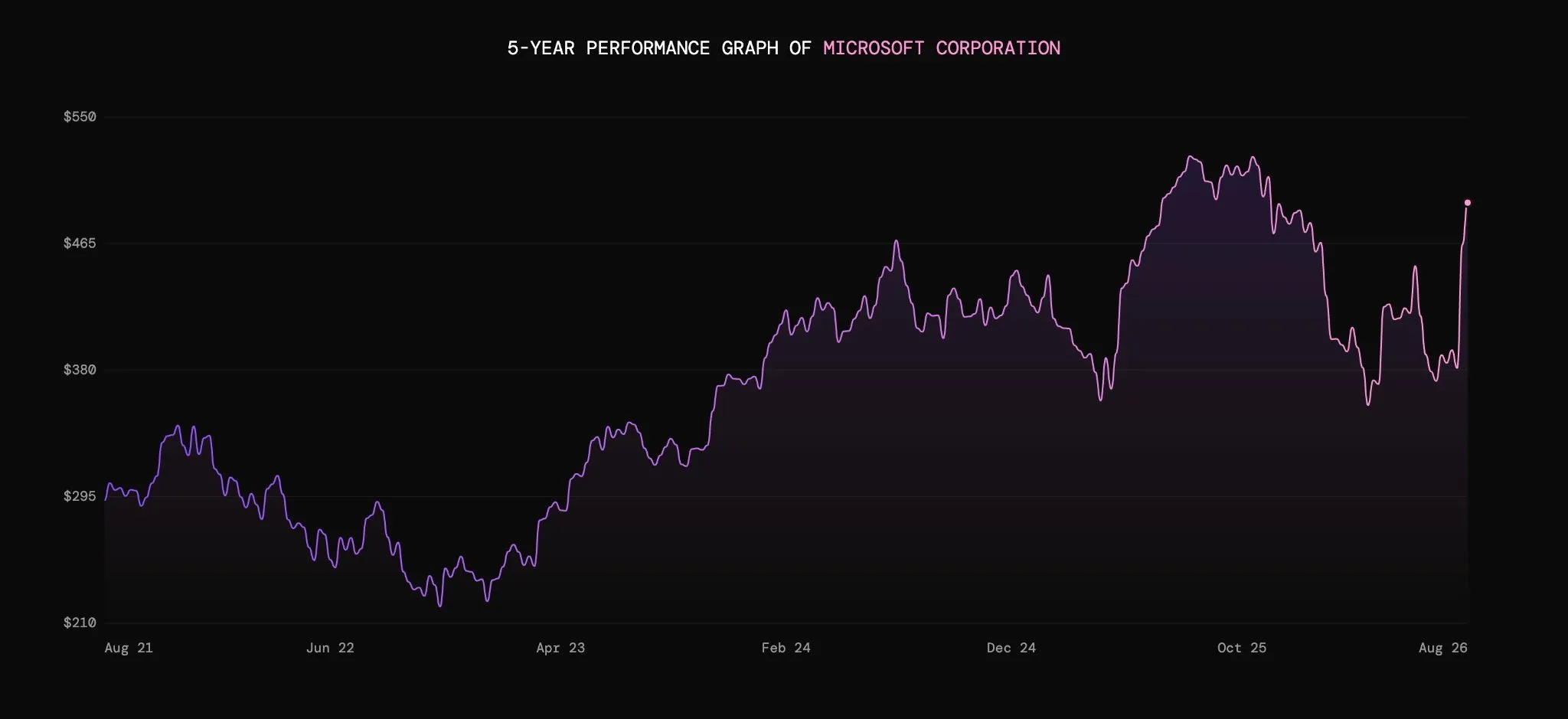
Microsoft is not alone in offering evidence of a return on investment, with Alphabet reporting Google Cloud revenue growth of 82% on the back of massive demand for AI infrastructure and AI solutions.
What this represents is an evolution for AI adoption.
The companies selling cloud services, software, and end-user applications are producing proof that customers are using, and paying for, their AI services. That might support continued demand for the chips, memory, and data-centre equipment underpinning those services.
Looking ahead, investors might cast a more selective eye over the various players as we find out who is winning or losing in the scramble to monetise AI. In other words: who is turning AI spending into sustainable profit, and who is merely spending to keep up?
Capital at risk. The value of your investments can go down as well as up and you may get back less than you invest.
Freetrade does not give investment advice and you are responsible for making your own investment decisions. If you are unsure about what is right for you, you should seek professional advice. Always do your own research.
Fluctuations in foreign exchange rates may affect investments denominated in currencies other than GBP and the amount you receive back.
.png)

.webp)
.webp)
.avif)