At 12:33 on 28 April 2025, the entire Iberian electricity system went kaput. Traffic lights failed, underground trains screeched to a halt, and mobile networks went down.
Emergency workers rescued around 35,000 passengers stranded on the railways and underground, and Madrid alone carried out 286 operations to liberate people trapped in lifts. With ATMs and online banking down, people rushed to banks for cash, and shop staff counted euros by hand because the tills had stopped working.
Most of the peninsula got its power back within about ten hours, but Spain wasn’t fully switched on until the early hours of the next morning, almost 16 hours after the blackout. Within days, Danish authorities were telling their own citizens to improve their home preparedness. The UK government wants us ready for the same thing, among other risks. Its Prepare website lists what to keep at home, and a national campaign launches before the end of the year.
Get out, stay out
Prepare splits emergencies into two kinds: the ones you sit out at home, and the ones where you have to bounce. The home kit includes a torch (safer than candles), a power bank, and a radio for updates, and entertainment. Add spare batteries, plus a backup battery for medical equipment. Then bottled water, tinned food (and tin opener), hand sanitiser and wet wipes, and pet food (for pets, not desperate humans).
The grab bag, or go bag, is lighter because you have to carry it. It should contain copies of birth certificates and insurance, essential medication, a phone charger, and spare glasses. One last piece of advice: If you’re escaping a fire, the advice is not to take anything at all.
Make do and mend
In the Cabinet Office’s 2026 survey, just 13% said their household was largely or totally prepared for an emergency, while 50% said slightly or not at all, much the same as in 2025.
At three litres of bottled water per person per day, only 4% had three or more days’ worth for their household, while 82% had less than one day. The share with three days of non-perishable, no-cook food fell from 66% in 2025 to 60%. Roughly 60% have spare batteries and 60% keep at least £10 cash per person. Just over half (54%) own a power bank and 53% a non-phone torch, but only 23% have a battery, solar, or wind-up FM radio.
Stay alert
The National Risk Register 2026 outlines 95 risks. Seven are new, including cyber attacks on data infrastructure, water infrastructure, and police systems.
Russia is the obvious driver. In July, the armed forces minister said Russia is a direct threat to the UK homeland. The public has noticed. Between 2025 and 2026, the share who thought war was likely to affect their local area within two years rose from 19% to 28%. On the eve of Labour’s conference, Defence Secretary Wes Streeting said Putin is testing the defences of the UK and NATO, and that the UK faces a greater risk of war than at any point in his lifetime.
Save it
Energy is where the cupboard looks barest. On average, Britain can store about 12 days of gas. Germany can store 89 days, France 103, and the Netherlands 123. The Rough field in the North Sea, run by Centrica (CNA), holds nearly half of UK capacity. Britain has long relied on imported liquefied natural gas and pipeline supplies instead of building reserves.
The Iran war has choked the Strait of Hormuz, which carries more than a fifth of the world's oil trade. The International Energy Agency has called it the largest supply disruption in the history of the global oil market.
And then that British perennial, the weather. UK temperature records were broken in May, and broken again in June, followed by a summer of wildfires. US forecasters have declared an El Niño, with Pacific sea temperatures more than 2°C above normal. Early signs point to a wetter, stormier autumn. The Met Office’s August forecast showed equatorial Pacific temperatures rising by more than 3°C. A typical El Niño adds 1°C to 2°C and 2°C counts as a major event.
If crisis or war comes
The message is blunt: don't assume help will come. Lord Harris, chair of the National Preparedness Commission, argues Britain needs a culture where households understand no one may arrive quickly to fix things when crisis hits. That’s sensible advice.
Much of all this has been going on in Europe for some time. Sweden sent its first If the war comes brochure to every household in 1943. In November 2024, it posted 5.2 million copies of the latest version, the fifth of its kind since the Second World War. Finland tells people to hold 72 hours of food, water, and medicine. In March 2025, the European Commission advised the same 72-hour benchmark for the whole bloc.
Go in, stay in, and tune in
This isn’t the first time the UK government has told Joe Public to prep. The Civil Defence Corps, a volunteer body created in 1949 to take charge locally after a major emergency (mainly a nuclear attack), had, at its peak, 330,000 members in 1956.
Protect and Survive was released in 1980. Its stay-at-home advice was widely mocked. It told households to build a refuge from doors, suitcases, and cushions, whitewash their windows, and fashion a toilet from a chair and a bucket. Historian E.P. Thompson hit back with a parody, Protest and Survive. The next attempt came in 2004. The government spent £8mn printing and posting Preparing for Emergencies to all 25 million UK homes. The 22-page booklet listed things to keep to hand, and its core instruction was “go in, stay in, and tune in”.
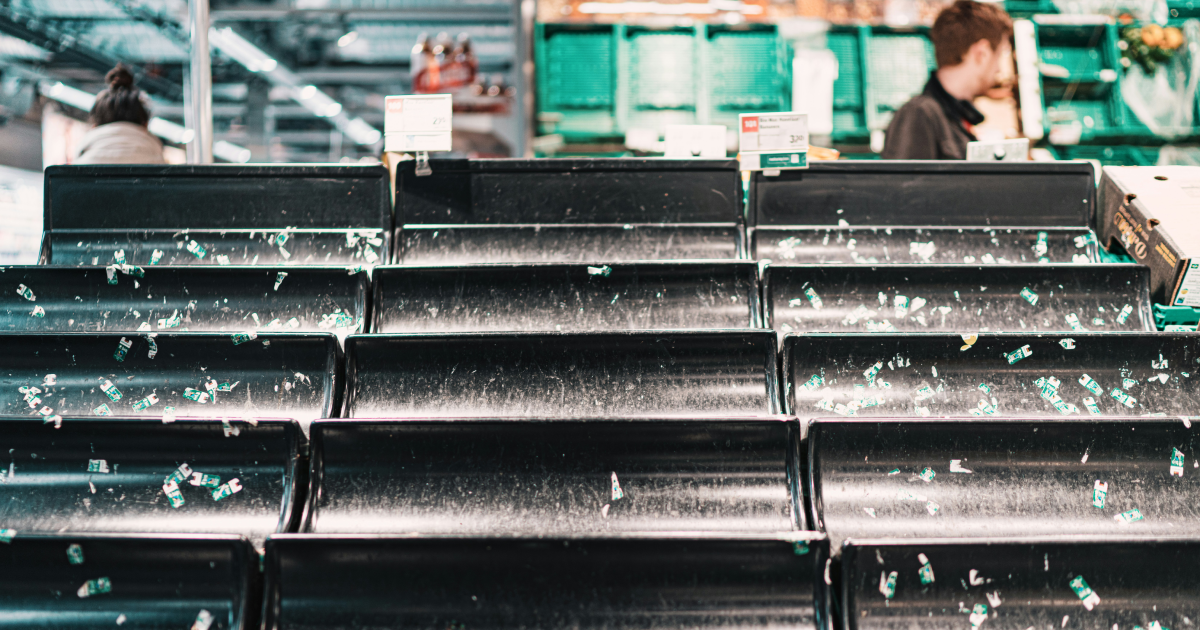
The pandemic showed what happens when nobody prepares in advance. In the week to 8 March 2020, toilet roll sales were 60% higher than a year earlier, dry pasta 55% and baked beans 48%. Kantar found that only 3% of dry pasta shoppers bought extraordinary quantities. Most of the damage came from shoppers buying a little extra.
Prepare. Act. Survive.
Prepping is one aspect of a broader zeitgeist, resilience. The word comes from the Latin resilire, to spring back. Its modern, systems meaning comes from ecology, where it describes how natural systems absorb shocks without collapsing.
Emphasis on resilience is a response to a choppier geopolitical environment. For three decades, globalisation operated with just-in-time supply chains, cheap imports, and lean inventories. With it, the hope that countries would become freer as they grew richer. Then came the 2008 financial crisis, Brexit, the pandemic, the Ever Given blocking the Suez Canal in 2021, Russia’s invasion of Ukraine and the subsequent energy crisis, Trump’s America First trade wars and tariffs, and now Hormuz.
Stay home, protect the NHS
Prepping can ease anxiety. But the opposite reaction is common. Nearly one in five Brits said they avoid thinking about worst-case scenarios. Prepare’s advice is to start small and build up, one can of beans at a time.
Prepping requires some degree of mass coordination. But in many ways we’re more atomised than ever. The government’s cohesion strategy, published earlier this year, warns social cohesion has been fraying for a decade and trust in institutions is falling. Just 38% of people in England say many people in their neighbourhood can be trusted, and among 16 to 34-year-olds it's 26%.
But the pandemic showed Britain can still muster that famous Blitz spirit. More than 4,000 local aid groups formed during 2020, with up to three million people involved, mostly doing the shopping for self-isolating neighbours.
Keep calm and carry on
As The Simpsons’ news anchor Kent Brockman, reporting on yet another bout of mass hysteria, once asked, is it time to crack each other’s heads open and feast on the goo inside? No. The risk register is just a planning document. Most of what’s in it is unlikely to happen in any given year. Planning for the what-ifs is just governing 101.
The world does feel more dangerous, and in some respects it is. Conflict deaths have risen in recent years. But by the measures that really matter, we’re safer than ever. Even war kills far fewer people than it did in the 20th century, and death rates from natural disasters have fallen by more than 90% over the last hundred years. This is thanks to early warnings, better infrastructure, productive farming, and working together. The world is safer because we prepared. We’re all preppers now.
The value of your investments can go down as well as up and you may get back less than you invest.
Freetrade does not give investment advice and you are responsible for making your own investment decisions. If you are unsure about what is right for you, you should seek professional advice.
.png)
.webp)